Skip to content
Urinary Incontinence: Step-by-Step Guide to do Kegels & Train Your Pelvic Floor Muscles at Home
Welcome to the third article in our four-part urinary incontinence series. Before you continue, we encourage you to read our first and second articles, “Urinary Incontinence: Types, Causes and Symptoms” and “How to Manage Urinary Incontinence: Care and Treatment”. which provide essential background information to help you get the most out of this article. This article covers Kegels & pelvic floor muscle training, form and tips.
What is Pelvic Floor Muscle Training (PFMT)?
Pelvic floor muscle training is an effective approach for individuals managing stress incontinence, urge incontinence (OAB), or both.
YouTube hosts a wide range of pelvic floor exercise videos designed to help both men and women strengthen these essential muscles. A strong pelvic floor reduces — and often eliminates — stress incontinence by supporting the urinary sphincter and improving overall muscle control. Regular practice not only alleviates symptoms but also prevents the condition from worsening. In men, pelvic floor exercises can improve sexual health and help last longer in bed. These exercises also help men with premature ejaculation. With consistent effort, noticeable improvements typically appear within six to eight weeks. In this article, I’ll share two specific exercises I’ve been practising that have profoundly enhanced my personal, social, and intimate life.
How to Train Your Pelvic Floor Muscles?
Half Bridge
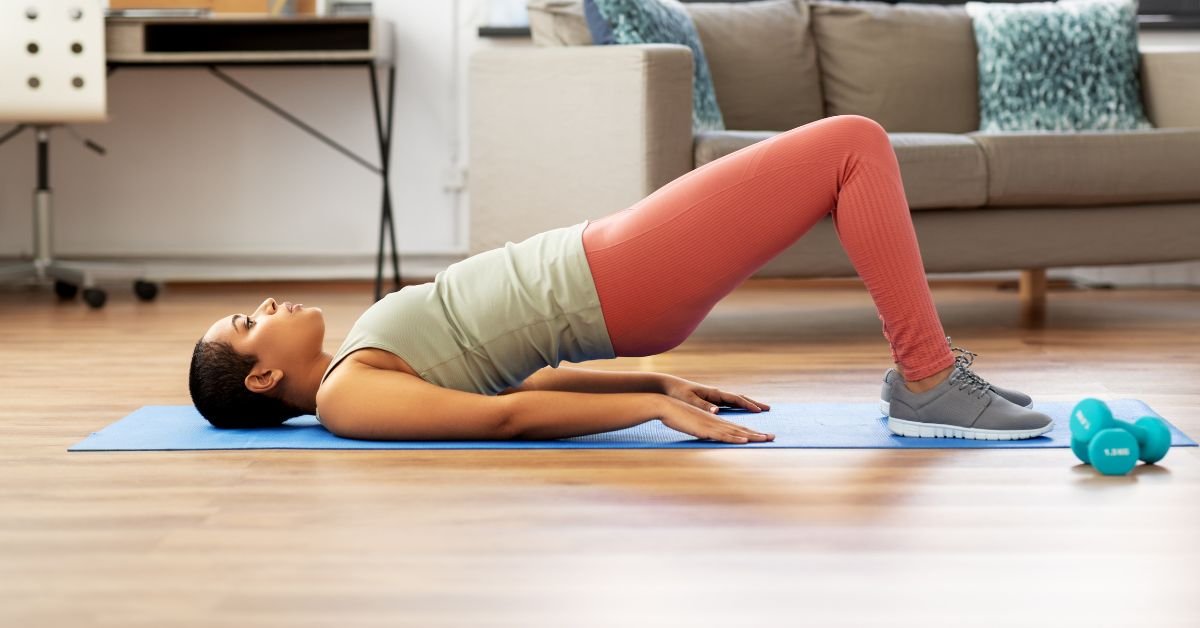
The half bridge — also known as the half bridge hold or glute bridge — is a modern-day variation of the Mula Bandha Asana (for perinium), Ashvini Mudra (for the anal sphincter) and Vajroli Mudra for men / Sahajoli Mudra for women (for the urogenital muscles) traditionally practised by ancient sages to strengthen and control the he full pelvic floor.
How do I Perform the Half Bridge Exercise?
- Set up position – Lie flat on your back on a mat, floor, or firm surface. Place your arms at your sides. Bend your knees and bring your heels close to your hips, keeping your feet hip‑width apart.
- Engage core – Press your lower back gently into the floor. Tighten your abdominal and glute muscles to prepare for the lift.
- Lift hips – Push through your heels only, raising your hips until your body forms a straight line from shoulders to knees. Keep your spine neutral — avoid arching your back.
- Activate pelvic floor – At the top of the movement, squeeze your pelvic floor muscles as if stopping urine flow or preventing gas from passing.
- Hold position – Maintain the lift for 20–30 seconds while keeping your core engaged and breathing steadily.
- Return to start – Slowly lower your hips back down to the floor, maintaining control throughout.
Half Bridge Adaptations
- For mobility or balance issues – The half bridge can also be performed on a firm bed, making it more accessible for individuals who find the floor challenging.
- For individuals with Spina Bifida or Spinal Cord Injury – This exercise requires strength in both legs to push the hips upward. If lifting your body is not possible, move on to the next exercise.
- Alternative option – The following exercise can be performed in any position and does not rely on physical strength, making it suitable for those unable to do the half bridge.
How many sets of Half Bridge should I do?
Start with a few twenty – twenty five repetitions at a time, then gradually increase both the repetitions and the number of sets. You should perform at least three sets of twenty five repetitions of this exercise per day.
Step-by-Step Guide to do Kegels
Kegel Exercise
Kegel exercise help to strengthen your pelvic floor muscles. Your pelvic floor muscles are the set of muscles you use to stop the flow of pee. Strengthening these muscles helps you prevent leaking pee or accidentally passing gas or poop. Doing Kegels helps with issues like stress incontinence, urge incontinence, faecal incontinence and pelvic organ prolapse. Kegels can also improve your sexual health and help improve your orgasms.
How do I Perform Kegel Exercise?
You perform Kegel exercise by lifting and holding, then relaxing your pelvic floor muscles. Squeeze your pelvic floor muscles as if stopping urine flow or preventing gas from passing.
You can do Kegels sitting or lying down. The best position to do Kegels is when you can feel your pelvic floor muscles working.
If you prefer performing Kegels sitting, start by moving forward from the back of the chair that you are sitting on now. Lift your chest and keep the inward curve in your lower back so you are sitting tall.
For individuals with Spina Bifida — and anyone who cannot sense their pelvic floor muscles — it’s best to begin Kegel exercise while lying down. Once you’re able to feel the pelvic floor engaging, you can progress to practising Kegels in other positions, such as standing or even while driving.
Steps for Men
Step 1 – Try to shorten or withdraw your penis inwards towards your body. Try now and see if you can feel that action. It is a very small, subtle movement. If you hold your fingers around the base of your penis, you may be able to feel the muscle that wraps around it contracting as your penis moves slightly inwards and towards your body.
Step 2 – Next, try to imagine that you are trying to stop or slow the flow of urine and contract around the base of your penis and then relax. Now, put step 1 and step 2 together. Shorten the penis and try to stop the flow of urine. And now relax.
Step 3 – This is the final part to get this exercise correct. Try to tighten your anus as if you are stopping gas from passing. This is the back part of the pelvic floor. You should feel your anus tighten, but your buttocks should stay relaxed. You shouldn’t be moving up and down in the chair; your buttocks should stay relaxed, and the anal sphincter tightens and relaxes.
Step 4 – Now combine all three steps and repeat.
Steps for Women
Step 1 – Try to tighten your anus as if you are stopping gas from passing. This is the back part of the pelvic floor. You should feel your anus tighten, but your buttocks should stay relaxed. You shouldn’t be moving up and down in the chair; your buttocks should stay relaxed, and the anal sphincter should tighten and relax. Tighten your anus and lift it inwards, as if you are trying to lift it upwards towards your navel as well as squeezing it shut. You should feel a squeezing and lifting sensation around your anus. Now relax and go back to resting.
Step 2 – Tighten and squeeze the entrance to your vagina as if you are closing it shut. Now, tighten your vagina and lift it inwards, as if there is a string drawing up from the top of your vagina, up inside towards your navel. Now, see if you can draw that up and in, and you might feel your anus tighten and your lower belly tighten too. That’s exactly what you want to happen. Now, relax back down to resting.
So, if you are having trouble feeling this exercise, try rolling up a hand towel and try sitting on it. The towel should be under your buttocks and between your legs, right under the buttock midline (crack). This can make it much easier to feel your Kegel exercise.
Step 3 – This is the final part to get this exercise correct. This time, try to tighten or imagine you are tightening the area in front of your vagina where your urine comes out. Imagine that you are stopping or slowing the flow of urine. Can you tighten this area? This can be a little difficult to feel, especially at first. You might also feel your anus and vagina tightening, too, and if you can, that’s great. Now, relax back down to resting. Take a nice deep breath in and out.
Step 4 – Now combine all three steps and repeat.
How many sets of Kegels should I do?
Start with a few Kegels at a time, then gradually increase both the duration and the number of Kegels you do in each ‘session’ (or set). You should perform at least two to three sets of this exercise per day.
Read our article “How You Can Treat Your Urinary Incontinence: A 10-Step Plan” to identify and fix your urinary incontinence in 10 easy steps.
Medical information
This article provides general educational information about Spina Bifida and is not a substitute for individual medical advice, diagnosis or treatment. Every person with Spina Bifida is different. Please discuss your individual circumstances with your qualified healthcare professional.
About the Author

Raul/DJ Vivek
Meet Vivek Bharadwaj, a remarkable individual who has defied the odds and soared to new heights despite living with Spina Bifida. As the founder of the Sasha Foundation, Vivek tirelessly advocates for others facing similar challenges. His unwavering commitment to support, awareness, and empowerment had made a lasting impact on the Spina Bifida community.