Skip to content

Management and Treatment for Urinary Incontinence
Welcome to the second article in our four-part urinary incontinence series. Before you continue, we encourage you to read our first article, “Urinary Incontinence: Types, Causes and Symptoms“, which provide essential background information to help you get the most out of this article.
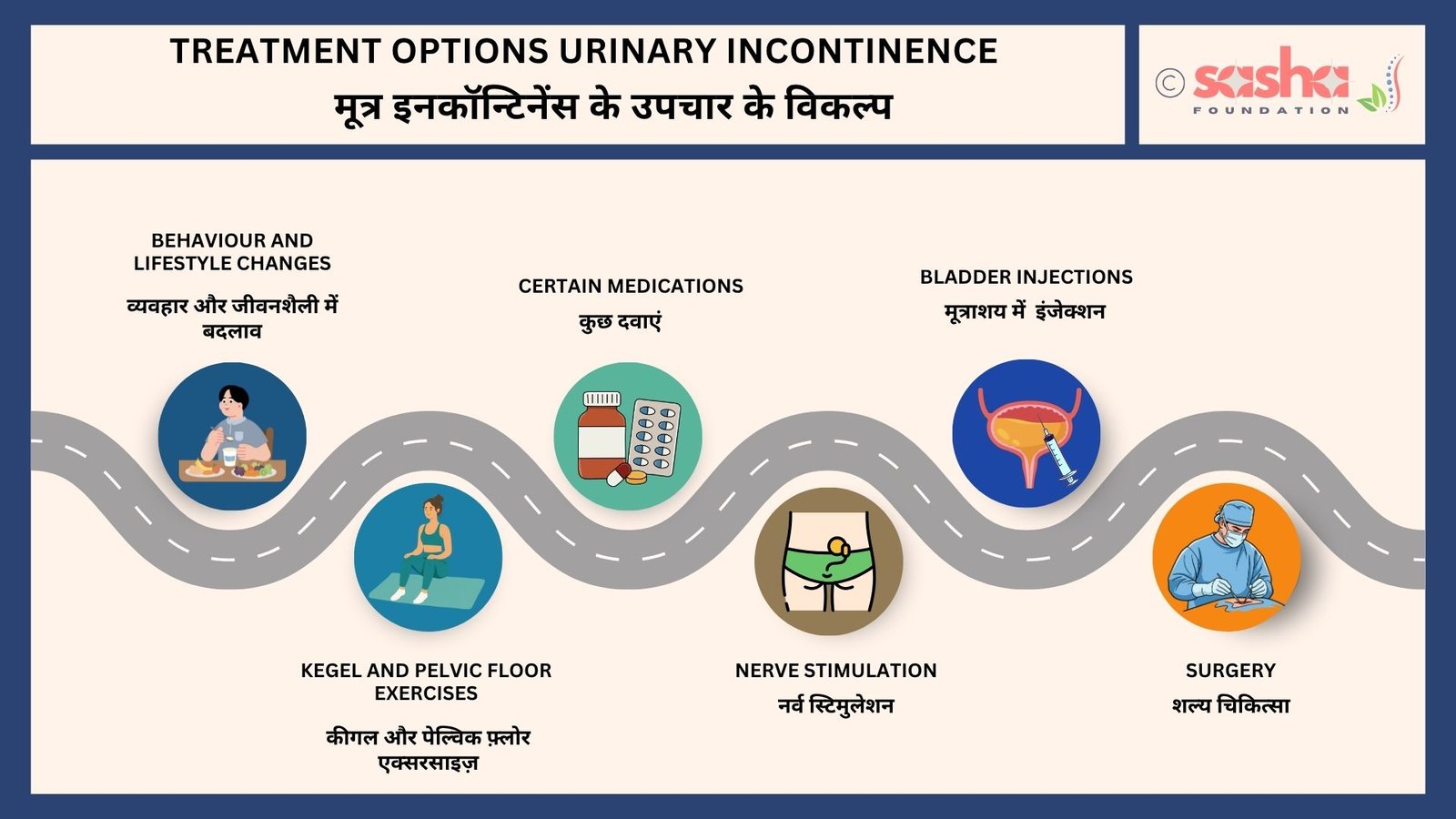
Management and treatment for urinary incontinence can be divided into two major categories – conservative and non-conservative. Conservative category includes non-invasive options and non-conservative category includes invasive options.
Conservative Options (Non-Invasive Options)
Behaviour and Lifestyle Changes
The following lifestyle and behavioural adjustments can significantly benefit individuals experiencing stress incontinence, urge incontinence (OAB), or both.
- Moderating fluid intake, especially during the day.
- Urinating or catheterising at set times (scheduled voiding).
- If catheterising, verifying proper bladder emptying is crucial.
- Avoiding food and drinks that could irritate the bladder, like alcohol and caffeine.
- Eating the right amount of fibre to prevent severe constipation, which can make stress incontinence worse.
- Maintaining a healthy weight for you.
- Avoiding jumping or running.
- Quitting smoking or using other tobacco products
- Managing conditions like diabetes and high blood pressure (hypertension)
Behavioural Techniques
The following behavioural techniques can significantly benefit able-bodied individuals experiencing urge incontinence (OAB) or overflow incontinence. The following might not apply to some individuals with Spina Bifida, spinal cord injury, stroke or nerve damage cases.
- Bladder training – To delay urination after you get the urge to go. You may start by trying to hold off for 10 minutes every time you feel an urge to urinate. The goal is to lengthen the time between trips to the toilet until you’re urinating only every 2.5 to 3.5 hours.
- Double voiding – To help you learn to empty your bladder more completely to avoid overflow incontinence. Double voiding means urinating, then waiting a few minutes and trying again.
- Scheduled toilet trips – To urinate every two to four hours rather than waiting for the need to go.
Pelvic Floor Muscle Training
Pelvic floor muscle training is an effective approach for individuals managing stress incontinence, urge incontinence (OAB), or both.
A strong pelvic floor reduces — and often eliminates — stress incontinence by supporting the urinary sphincter and improving overall muscle control. Regular practice not only alleviates symptoms but also prevents the condition from worsening. In men, pelvic floor exercises can improve sexual health and help last longer in bed. These exercises also help men with premature ejaculation. With consistent effort, noticeable improvements typically appear within six to eight weeks. In this article, I’ll share two specific exercises I’ve been practising that have profoundly enhanced my personal, social, and intimate life.
Half Bridge
The half bridge — also known as the half bridge hold or glute bridge — is a modern-day variation of the Mula Bandha Asana, traditionally practised by ancient sages to strengthen and control the anal sphincter.
Kegel Exercise
Kegel exercises help to strengthen your pelvic floor muscles. Your pelvic floor muscles are the set of muscles you use to stop the flow of pee. Strengthening these muscles helps you prevent leaking pee or accidentally passing gas or poop. Doing Kegels helps with issues like stress incontinence, urge incontinence, faecal incontinence and pelvic organ prolapse. Kegels can also improve your sexual health and help improve your orgasms.
How to practice Half Bridge and Kegel exercises at home? Read our article “Urinary Incontinence: Kegels & Pelvic Floor Training at Home“.
Medications
The following medicines can help individuals manage urinary incontinence:
- Anticholinergics – These medications can calm urge incontinence (OAB). Examples include oxybutynin (Ditropan XL, Tropan), tolterodine (Detrol, Terol), darifenacin (Enablex, Dariten), fesoterodine (Toviaz, Fesobig), solifenacin (Vesicare, Soliten) and trospium chloride (Trofame).
- Mirabegron (Myrbetriq) – Mirabegron is used to treat urge incontinence (OAB), this medication relaxes the bladder muscle and can increase the amount of urine your bladder can hold. It may also increase the amount you are able to urinate at one time, helping to empty your bladder more completely.
- Alpha blockers – In men who have urge incontinence (OAB) or overflow incontinence, these medications relax bladder neck muscles and muscle fibres in the prostate and make it easier to empty the bladder. Examples include tamsulosin (Flomax, Contiflo Icon), alfuzosin (Uroxatral), silodosin (Rapaflo, Silofast), and doxazosin (Cardura).
Non-Conservative Options (Invasive Options)
Interventional Therapies
If bladder retraining and lifestyle changes don’t help, a healthcare provider may recommend:
- Botulinum toxin (Botox®) injections.
- Urethral bulking agents
- Neuromodulation.
Botox
Injections of Botox into the bladder muscle may benefit people who have an overactive bladder and urge incontinence. Botox is generally prescribed to people only if other treatments haven’t been successful. Botox helps relax your bladder muscles so it can hold more pee. Botox also paralyses the urinary bladder, killing its involuntary movements, and helps stop urine leakage. Botox is administered through cystoscopy. In some parts of the world, it is performed under general anaesthesia, and in other parts under local anaesthesia.
Please note: For the past decade, I’ve relied on Botox injections in my bladder, and the results have been immensely beneficial. However, Botox comes with two major challenges. First, it remains a costly treatment option in India, though certain workarounds exist. Second, its effects are temporary — as the benefits wear off, repeat procedures become necessary, and the duration of relief tends to shorten over time. I’ll be exploring these issues in greater detail in an upcoming article. I strongly recommend Botox if you have the means, but remember it is a lifelong commitment.
Urethral Bulking Agents
The urethral bulking agent procedure is widely used for women, but some urologists across the globe are opting for this procedure for men, as well. Please note that this procedure was invented keeping women in mind. This procedure treats stress incontinence, and it may need to be repeated over time, just like Botox. The repetition frequency differs from Botox.
In women:
A synthetic material is injected into tissue surrounding the urethra. The bulking material helps keep the urethra closed and reduce or stop urine leakage.
In men:
A synthetic material is injected into the urinary sphincter at chosen places. The bulking material helps keep the urinary sphincter closed and reduce or stop urine leakage.
The urethral bulking agent is administered through cystoscopy. In some parts of the world, it is performed under general anaesthesia, and in other parts under local anaesthesia.
Please note: Urethral bulking agent therapy remains a costly option in India, yet it has the potential to greatly improve quality of life. I’ve learned of a doctor based in Surat who is reportedly the only practitioner in the country performing this procedure. Conversations with his patients suggest that the outcomes have been truly remarkable. I’m eager to meet him to gain deeper insight, and I plan to share my experience — along with practical guidance on how to pursue this treatment in India — in a forthcoming article.
Neuromodulation
There are three approaches to gently stimulating the nerves that are involved in bladder control. This helps regulate how your nervous system communicates with your bladder. These approaches include:
Percutaneous tibial nerve stimulation (PTNS)
PTNS stimulates a nerve right above your ankle. You’ll undergo weekly sessions for 12 weeks.
Implantable tibial nerve stimulation (ITNS)
This involves a procedure to place a small implant near your ankle to stimulate your posterior tibial nerve.
Sacral neuromodulation (SNM)
This is an implant in your lower back. A provider inserts a small wire near the base of your spine to provide constant, gentle stimulation more directly to the nerve that supplies your bladder. They’ll implant a small battery under your skin.
Neuromodulation has shown strong results in able‑bodied individuals who develop urinary incontinence, with substantial data supporting its effectiveness. It has also proven beneficial in cases where someone was fully functional at birth but later experienced incontinence following an accident. However, outcomes are far less promising for individuals with Spina Bifida (SB), where nerve damage is present from birth. In my experience, the few success stories I’ve encountered involve children who underwent sacral neuromodulation (SNM) before reaching puberty. I’ll be mentioning links to these stories at the end of this article in my final thoughts section.
Medical Devices
The following devices can help women manage urinary incontinence:
- Urethral insert – A small, tampon-like disposable device inserted into the urethra before a specific activity, such as tennis or exercise, that can trigger incontinence. The insert acts as a plug to prevent leakage and is removed before urination. This is a use-and-throw solution.
- Vaginal Pessary – A pessary is a ring-shaped silicone device inserted into the vagina. Pessaries push the urethra closed to help control urine leakage and allow you to urinate normally throughout the day. Some women wear a pessary only when exercising, but others leave it in, depending on when their symptoms are most bothersome.
Surgeries
In my opinion, surgery should be the last option. Surgery is only recommended after the cause of the incontinence is known, and all conservative and non-conservative methods are exhausted. Surgical options include:
Sling Procedures
This procedure is used to treat stress incontinence.
In women, a synthetic material (mesh) or strips of your body’s tissue are used to create a pelvic sling underneath your urethra and the area of thickened muscle where the bladder connects to the urethra (bladder neck). The sling helps keep the urethra closed, especially when you cough or sneeze. There are two types of sling procedures, tension-free slings and conventional slings. For the tension-free sling procedure, your surgeon will likely recommend a retropubic procedure or a transobturator procedure. For the conventional sling procedure, your surgeon will likely recommend a retropubic sling or a transobturator sling.
In men, a soft, synthetic (human-made), mesh-like surgical tape is used around part of your urethral bulb (bulb of penis). The surgical tape elevates and reinforces your urethra (the tube through which pee leaves your body) and bladder neck. The urethral bulb helps you control when you pee, especially during exercise. The two most common male slings are the AdVance® sling and the Coloplast Virtue® male sling.
Bladder Neck Suspension
This procedure is used to treat stress incontinence in women. This procedure is designed to provide support to your urethra and bladder neck — an area of thickened muscle where the bladder connects to the urethra. It involves an abdominal incision, so it’s done during general or spinal anaesthesia.
Artificial Urinary Sphincter
This procedure is to treat severe stress urinary incontinence in men. A small, fluid-filled ring is implanted around the bladder neck to keep the urinary sphincter shut until there’s a need to urinate. To urinate, you press a valve implanted under your skin that causes the ring to deflate and allows urine from your bladder to flow. Mind you, to implant this artificial sphincter, the natural sphincter has to be removed/replaced. Depending on the company, this sphincter has a life cycle, and the procedure needs to be repeated.
Other Products Designed to Help you Manage Urinary Incontinence
Absorbent Pads, Diapers and Catheters
If medical treatment is not an option for you, or if it has not fully eliminated your incontinence, there are products designed to help you manage leakage comfortably and discreetly. They can reduce the inconvenience of accidental urine loss, help you maintain your daily activities with greater confidence, and support you on your journey toward better bladder health.
Pads and Protective Garments
Modern products are designed to be discreet, often no bulkier than regular underwear, and can be worn comfortably under everyday clothing. The market today offers a wide range of diapers and urine pads, tailored to different levels of leakage. Options range from light absorbency for mild leakage to heavy absorbency for more significant needs, with prices varying accordingly. By considering both your monthly usage and budget, you can make an informed choice. Pads are discreet and simple to wear over underwear, easy to dispose of, and virtually invisible thanks to today’s advanced designs. Urine pads are best for individuals who only have urinary incontinence. I’ll be adding useful links at the end of this article for reference.
Diapers
Unlike pads, diapers tend to be bulkier and more noticeable under clothing. That said, they offer a practical advantage in terms of cost and utility for individuals dealing with both urinary and faecal incontinence — addressing two needs with a single product. However, diapers are generally less convenient to wear and dispose of compared to urine pads, and for many, the psychological barrier of using them can be significant, especially if it’s a new experience.
Diapers may also affect personal confidence and intimacy, sometimes playing a challenging role in one’s love life. They are available in two common styles:
- Pant‑style diapers – Best suited for independent individuals without mobility issues, as they can be worn like regular underwear.
- Side‑stick diapers – Designed for those who rely on caregivers and face mobility challenges, making them easier to manage in assisted care settings.
I’ll be adding useful links at the end of this article for reference.
Other Important Means
Catheter
If you’re incontinent because your bladder doesn’t empty properly, your doctor may recommend that you learn to insert a soft tube (catheter) into your urethra several times a day to drain your bladder. You can read our step-by-step guide on self-catheterization for men here and for women here.
If you are a Spina Bifida or a spinal cord injury individual with neurogenic bladder, you should be self-catheterising on time, daily. It will help you reduce or stop urine leakage. You can read our guide on self-catheterization here and what precautions to take here.
Drip Collector
Men who have problems with dribbles of urine can use a drip collector — a small pocket of absorbent padding that’s worn over the penis and held in place by close-fitting underwear.
Condom Catheter with Collection Bag
For men who experience leakage but prefer not to use pads or diapers, a condom catheter with a urine collection bag can be a practical alternative. This device works by fitting a condom‑like sheath over the penis, which is connected to a catheter. The catheter then drains urine into a bag that must be purchased separately. The bag can be secured to the thigh, attached to a wheelchair, or kept at the side, depending on convenience. For thigh placement, specially designed bags with dedicated attachments are available, making the system more discreet and manageable.
SASHA’s Note
If all of this information feels like a lot to take in, you’re not alone. To help make identifying your symptoms and choosing the right treatment path easier, we have created a guide called “How You Can Treat Your Urinary Incontinence: A 10-Step Plan.” Read it alongside this article and use it as a practical tool to discuss and develop a personalised treatment plan with your healthcare provider.
Sacral Neuromodulation (SNM) Success Story Links
Sacral neuromodulation (SNM) Success story details and links
- One such article about a success story of a Dubai-based doctor, Professor Dr Haluk Kulaksizoglu of Neurospinal Hospital Dubai, and his patient can be read here.
- Another such article about a success story of a Pune, India-based doctor, Dr R.K. Shimpi, a senior urologist and robotic surgeon of Inamdar Mult Speciality Hospital Pune, and his patient can be read here and here.
Links to Some of the Necessary Items We Talked About
These sellers we are mentioning here have not sponsored this and are not affiliated in any way or form. Please feel free to buy what you please, our goal is to guide you in the right direction. Disclaimer: we haven’t tried all the products mentioned here so we don’t take responsibility for durability or fit.
Pads for men:
- Tried and tested everyday discreet light pads (leak level 1) for men: TENA MEN Level 1 Bladder Control Guards for Light Urine Leaks | Ultra thin
- Tried and tested everyday light pads (leak level 2) for men: Seni Man High Absorbency, Breathable Light Pads
- Tried and tested everyday heavy pads (leak level 3) for men: Romson DIGNITY Man Light Incontinence Pads for Leakage Protection
- Tried and tested everyday high absorbency pads (leak level 5) for men: Seni Man Premium Bladder Control Guards Fit Pads
Pads for women:
- Everyday medium bladder weakness pads (leak level 4) for women: TENA Lady Normal Pads for Medium Bladder Weakness | Upto 12 hrs Dryness
- Everyday long bladder control heavy pads (leak level 5) for women: Seni Lady Premium Maximum Long Bladder Control Pads
- Everyday overnight bladder leakage protection pads (leak level 7) for women: Seni Lady Premium Women Ultimate Long Bladder Control Pads
Pant Style Diapers:
- Comfrey Adult Pant Type Easy Wear Diapers
- CIR Adult Diaper Pants Style
- Karein Classic Adult Diaper Pant
Side Stick Diapers:
Urine Collector for Men and Women:
Condom Catheter:
Medical information
This article provides general educational information about Spina Bifida and is not a substitute for individual medical advice, diagnosis or treatment. Every person with Spina Bifida is different. Please discuss your individual circumstances with your qualified healthcare professional.
About the Author

Raul/DJ Vivek
Meet Vivek Bharadwaj, a remarkable individual who has defied the odds and soared to new heights despite living with Spina Bifida. As the founder of the Sasha Foundation, Vivek tirelessly advocates for others facing similar challenges. His unwavering commitment to support, awareness, and empowerment had made a lasting impact on the Spina Bifida community.