Skip to content

10 Steps to Identify & Fix Urinary Incontinence
Welcome to the fourth article in our four-part urinary incontinence series. Before you continue, we encourage you to read our first article, “Urinary Incontinence: Types, Causes and Symptoms” and “How to Manage Urinary Incontinence: Care and Treatment“, which provide essential background information to help you get the most out of this article. If not, These articles will help you understand urinary incontinence, and conservative and non-conservative treatment options in detail. This step-by-step guide of mine will help you conclude which type of urinary incontinence you have, and how effectively you can tackle it.
Your steps to identifying and fixing urinary incontinence are:
Step 1: Come to terms with the fact that you have a challenge called urinary incontinence.
Step 2: Identify what kind of urinary incontinence you have.
- Stress incontinence?
- Urge incontinence or overactive bladder (OAB)?
- Overflow incontinence? Or
- Mixed incontinence?
Step 3: Identify the management and treatment for your urinary incontinence.
Step 4: Divide these management and treatment options into two categories. Please follow the order in each category. The categories are:
- Conservative (non-invasive) category
- Non-conservative (invasive) category
Step 5: Try the conservative categories first, in combination with another conservative category. The conservative category includes:
- Behaviour and lifestyle changes
- Pelvic floor muscle training
- Medications
Pelvic floor muscle training, along with Kegels can help resolve incontinence. Please read our article “Urinary Incontinence: Kegels & Pelvic Floor Training at Home” to learn to practice the right way.
Step 6: In most cases, a combination of medication and pelvic floor training significantly reduces or resolves incontinence within approximately three to four months. I would suggest giving yourself 6 months.
Step 7: If conservative approaches fail to deliver the desired results, it’s time to move on to the next step. When considering outcomes, remember to keep expectations realistic and practical. Any option moving forward is not going to be pocket-friendly. In some parts of the world, insurance covers these options. The non- conservative category includes:
- Interventional Therapies
- Medical Devices
- Surgeries
Step 8: If you progress to non‑conservative treatment options, begin by combining interventional therapies from that category, while continuing pelvic floor muscle training from the conservative category. The therapies to try first are:
- Botox (for overactive bladder) + pelvic floor muscle training
- Urethral bulking agents (for stress incontinence) + pelvic floor muscle training
- Botox + urethral bulking agents (for mixed incontinence) + pelvic floor muscle training
You may also add medications from the conservative category to the combination, providing an extra boost if therapy alone does not deliver the expected results.
Step 9: If interventional therapy options mentioned above fail, try the following medical device
- Sacral neuromodulation (SNM) + pelvic floor muscle training
Step 10: If the options mentioned above fail to deliver the desired results, it’s time to move on to the last option – surgery. Surgery is a costly option and can take a toll on your body. However, in some parts of the world, insurance will cover the cost. Your healthcare provider will suggest a surgery based on your condition and gender.
- Sling Procedure
- Bladder Neck Suspension
- Artificial Urinary Sphincter
Steps to identify and fix urinary incontinence (explained in English)


Steps to identify and fix urinary incontinence (explained in Hindi)
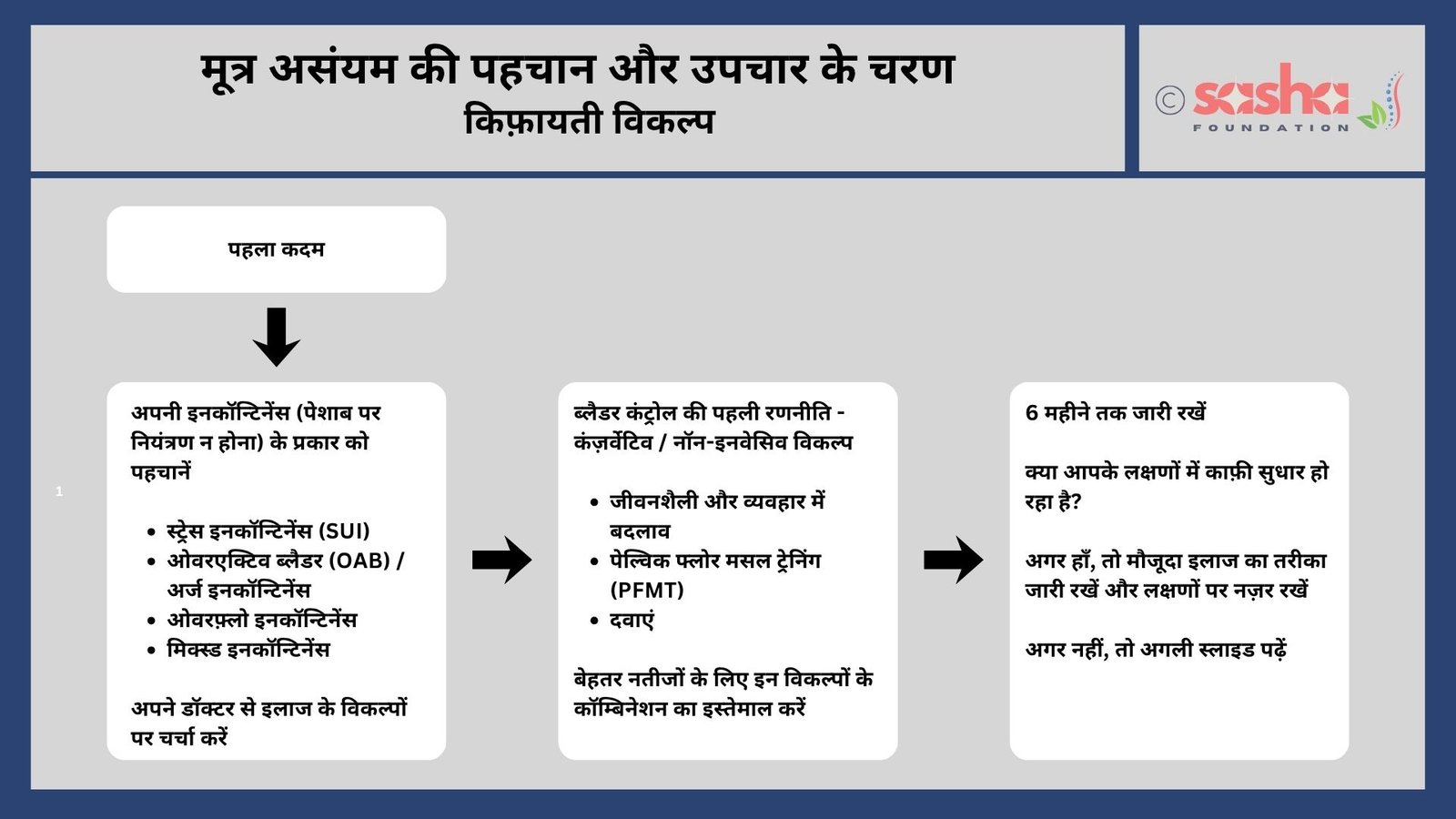
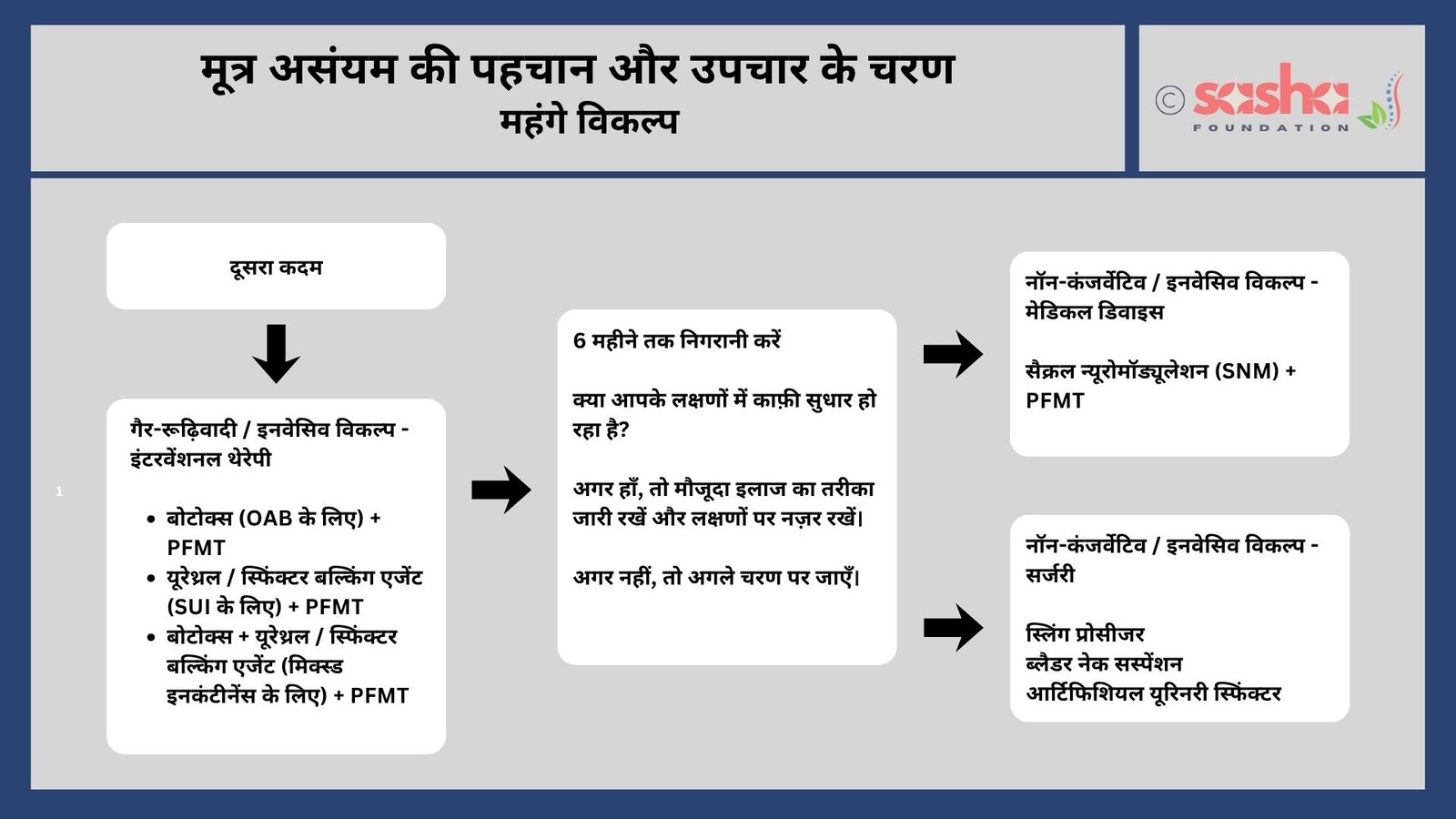
Discuss all the options with your healthcare provider and make a solid plan for yourself. Most people will see results at Point No.5. Talk to me if you have doubts or want to share some thoughts.
Medical information
This article provides general educational information about Spina Bifida and is not a substitute for individual medical advice, diagnosis or treatment. Every person with Spina Bifida is different. Please discuss your individual circumstances with your qualified healthcare professional.
About the Author

Raul/DJ Vivek
Meet Vivek Bharadwaj, a remarkable individual who has defied the odds and soared to new heights despite living with Spina Bifida. As the founder of the Sasha Foundation, Vivek tirelessly advocates for others facing similar challenges. His unwavering commitment to support, awareness, and empowerment had made a lasting impact on the Spina Bifida community.