Skip to content

Welcome to the third article in our three-part “3 Common Urinary Problems and How to Treat Them” series. We encourage you to read the other two articles, “Urinary Incontinence: Types, Causes and Symptoms“ and “Urinary Retention: Causes, Symptoms and Treatment”, which provide essential information on other urinary problems and how to treat them.
In this article, we will explore urinary tract infections (UTIs) — a common urinary complication affecting able‑bodied individuals as well as those with Spina Bifida, spinal cord injuries, or nerve damage. We will also examine the available treatment options and practical strategies for managing the condition.
Urinary Tract Infections (UTIs)
What are Urinary Tract Infections (UTIs)?
Urinary Tract Infections (UTIs) are common infections that affect millions of individuals each year. These infections occur when harmful bacteria invade the urinary system, which includes the kidneys, ureters, bladder, and urethra. UTIs can initiate in any part of this system but most frequently occur in the bladder and urethra. UTIs in different parts are known by different names, which are:
- Bladder (cystitis)
- Urethra (urethritis)
- Kidneys (pyelonephritis)
Almost 90% of UTIs are caused by the bacterium Escherichia coli (E. coli). A fun fact: E. coli is present in our gut and does not cause any harm — it even helps you digest your food. But under certain circumstances, many strains (types) of E. coli can make you sick.
Infections confined to the lower urinary tract can be painful and disruptive, but they often resolve on their own within a few days. If symptoms persist, antibiotic treatment may be necessary. As with any infection, delaying care increases the risk of complications. A symptomatic UTI — with signs such as fever, blood in the urine, smelly urine or cloudy urine — left untreated can progress and ultimately cause kidney damage.
Urinary Tract Infection Symptoms
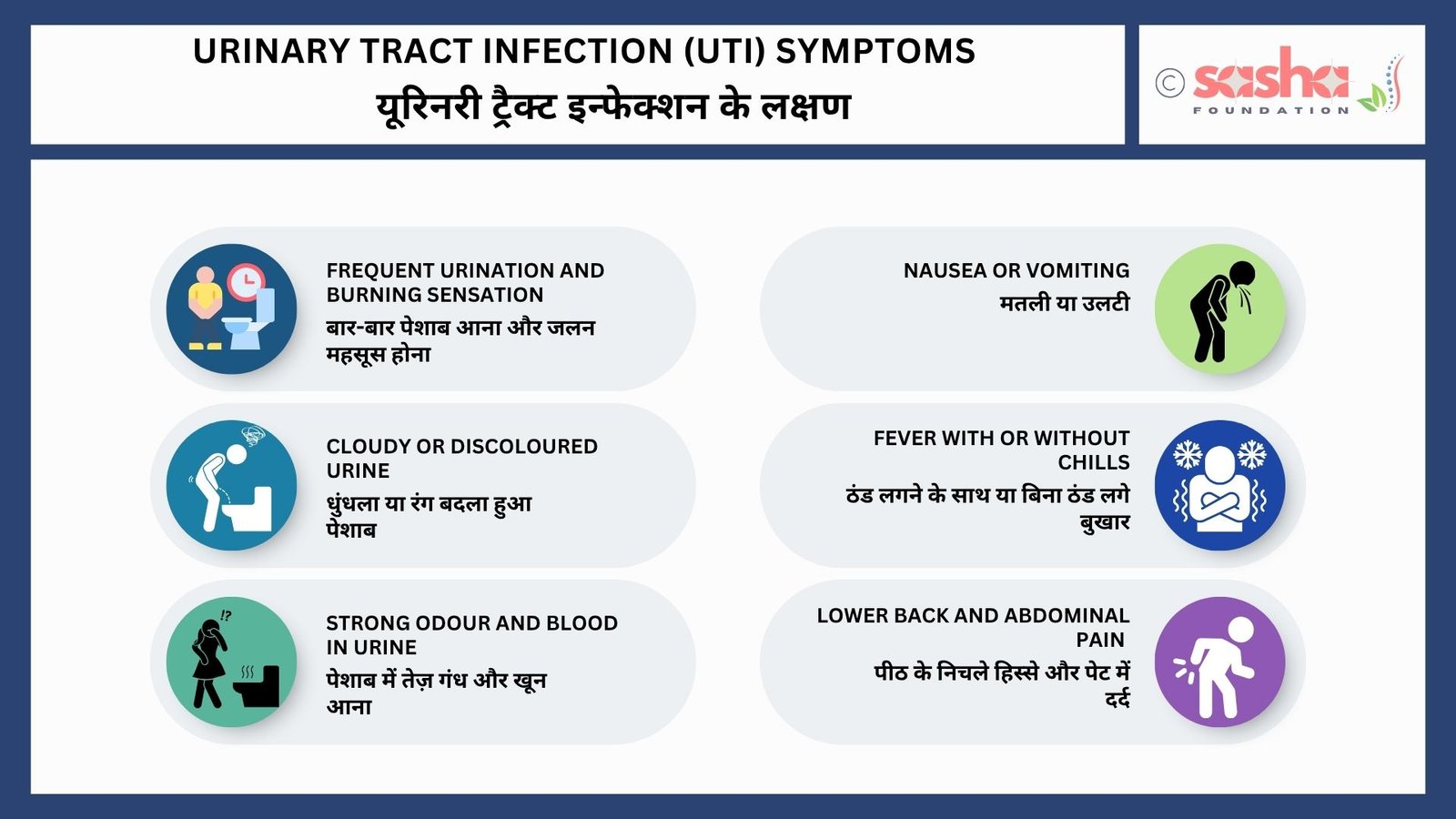
Urinary tract infections (UTIs) show up in different ways because they are caused by bacteria in the urinary system. The signs can be different for each person, but the most common symptoms of a UTI include:
- Frequent urination – Individuals suffering from a UTI may experience a frequent urge to urinate or catheterise.
- Burning sensation – A burning sensation or pain during urination or catheterization is a typical symptom of a UTI. It indicates the urinary tract is irritated.
- Urgency to urinate – Along with needing to urinate often, people with UTIs may also feel a sudden, strong urge to urinate immediately.
- Cloudy or discoloured urine – Urine may appear cloudy or discoloured.
- Blood in urine – Urine may have a pinkish colour due to the presence of blood.
- Strong odour – UTIs can cause urine to develop a strong, unpleasant, unbearable smell.
- Lower back and abdominal pain – Some individuals may experience discomfort or pain in the abdominal region, pelvis, or lower back. This discomfort or pain may get worse during urination.
- Fever with or without chills – In many people, a UTI can cause a moderate to high fever with or without chills. This usually indicates that the infection has spread beyond the urinary tract.
- Fatigue – A UTI may be accompanied by fatigue. Many people feel generally unwell.
- Nausea or vomiting – Many people with a UTI feel like throwing up.
Causes of Urinary Tract Infections
UTIs occur when bacteria enter the urinary tract through the urethra and begin to spread in the bladder. The human urinary system is designed to keep the bacteria out. But sometimes the defences fail. When our body’s first line of defence fails, bacteria may take hold and grow into a full-blown infection in the urinary tract. The human immune system differs from person to person, which means our defences against bacteria vary. When harmful bacteria overpower the body’s defences, symptoms such as pain and fever appear as the body’s response. Several factors contribute to susceptibility to UTIs, including gender, anatomical differences, urinary retention, and the presence of urinary stones.
Who is More at Risk of Getting a Urinary Tract Infection (UTI)?
Several risk factors contribute to urinary tract infections, and it is important to be aware of them.
Gender
Nature’s been discriminatory towards women when it comes to UTIs. Urinary tract infections are more common in women than in men due to their anatomy. Reasons why women are more prone to UTIs than men are:
- A woman’s urethra is shorter than a man’s urethra. shorter urethra makes it easier for bacteria to travel along the urethra and infect the bladder.
- The short distance between the anus and the urethral opening increases the risk of a UTI caused by E. coli. Remember, E. coli is present in the poop.
- In women, wiping or cleaning their bottom from back to front after pooping can cause an E. coli UTI. Women should always wipe or clean front to back.
- Changes in vaginal flora, e.g. via the use of spermicides.
- Pregnancy due to hormonal changes, etc.
- Menopause, with declining levels of estrogen.
Urinary Catheter Usage (Self-catheterization)
People who can’t urinate on their own use a tube, called a catheter, to remove urine from the bladder. They practice this multiple times a day, as and when the bladder fills up. This process is called Clean Intermittent Self-Catheterization (CISC/CIC/IC). Using a catheter raises the risk of UTIs. As a matter of fact, anything inserted into the urethra, including surgical examinations performed at hospitals, actually increases the risk of infection. In most cases, improper handling and/or poor hygiene while catheterising can lead to UTIs. People who self-catheterise may face recurrent UTIs. You can read our step-by-step guide on self-catheterization for men here and for women here.
Sexual Activity
Sexual activity is one of the biggest reasons for reported symptomatic UTIs.
- Sexual activity in both men and women can cause UTIs. Intercourse can introduce bacteria into the urinary tract, especially in women (the vagina is close to the rectum).
- Women who change sexual partners or begin having sex more often also tend to experience UTIs.
- A person who practices self-catheterization has a very high chance of catching a UTI post sexual activity. Not just intercourse, even oral sex can lead to UTIs in people who self-catheterise.
Age
As people age, changes in the urinary tract can make them more prone to infections, including UTIs. In fact, UTIs are one of the most common infections among older adults. Men and women above 65 are more susceptible to UTIs.
Certain Medical Conditions
Conditions like diabetes, bladder or kidney stones, or bowel dysfunction can increase the risk of contracting a UTI.
Not Drinking Enough Fluids
Staying hydrated dilutes urine and promotes frequent urination, which helps prevent bacterial buildup. Not drinking enough fluids increases the risk of urinary tract infections (UTIs) because concentrated urine allows bacteria to thrive and reduces the natural flushing action that helps clear microbes from the bladder and urethra.
What is Bacteriuria? What is the Difference Between Bacteriuria and a UTI?
Bacteriuria, or asymptomatic bacteriuria, is when you have bacteria in your urine, but it is asymptomatic — you don’t have symptoms of a urinary tract infection. So basically, you are infected, but you yourself are not aware of it. It’s very common, and treatment is not required in most cases. All the telltale symptoms of a urinary tract infection are missing, which means no discomfort and no suffering.
A bacteriuria can only be identified through a urine culture test. Pregnant women, kidney transplant recipients and people who are having certain procedures may be treated with antibiotics. Older adults and people who use a catheter are more likely to have asymptomatic bacteriuria.
Bacteriuria and Intermittent Self-catheterization (IC)
Bacteriuria is very common in people practising Intermittent Self-catheterization (CISC/CIC/IC). In fact, some studies show up to 60% of people who self-catheterise have bacteriuria. If you practice CIC or IC and develop asymptomatic bacteriuria, it means bacteria are present in the urine without any symptoms. In such cases, no treatment is needed, and antibiotics should not be used.
How to Prevent Urinary Tract Infections?
You may be able to reduce the risk of UTIs by following hygiene protocols and implementing some lifestyle changes. The proven ways to avoid UTIs are:
Cranberries: For a UTI to develop, bacteria like Escherichia coli (E. coli) must anchor themselves to the tissue lining your urinary tract and bladder. Cranberries contain a substance that blocks the bacteria from sticking to the bladder wall; the bacteria remain suspended in the urine and are easily flushed out of the body when you urinate. Please note cranberries can prevent, not cure.
Stay Hydrated: Drink a lot of water every day. Drinking fluids, in particular water, dilutes the urine and helps flush bacteria out of the urinary tract through frequent urination.
Maintain Appropriate Hygiene: Always wipe or clean from front to back after pooping to prevent bacteria from entering the urethra from the anus. Regularly wash the skin around the rectum and genital areas.
Steps After Sex: Urinating after sexual activity helps flush the bacteria out. Wash the skin around the vagina or penis with water before and after sex.
Avoid Severe Constipation: Severe constipation can prevent the bladder from emptying completely, leaving behind residual urine that becomes an ideal breeding ground for bacteria.
Avoid Harsh Hygiene Products and Irritants: Certain body washes, moisturisers, and deodorising sprays can disturb the urinary tract’s natural bacterial balance, making it more vulnerable to infections. Do not use them on or around the genital area.
Special Care: People Who Self-catheterise: People who practice self-catheterization (CISC/CIC/IC) have to go above and beyond to avoid UTIs. If you practice IC, strictly follow hygiene protocols recommended by SASHA. Read our article “3 Steps for Infection-Free Self-Catheterization“.
What Tests Will be Done to Diagnose a UTI?
If you are experiencing any or multiple symptoms mentioned here, you may have contracted a urinary tract infection (UTI). Talk to a healthcare provider, preferably a urologist. Your healthcare provider may order the following tests:
Urine Routine
You’ll urinate into a special cup; lab technicians will test your sample for urine colour, clarity, and concentration, pH levels, protein, blood, nitrites, leukocyte esterase, red and white blood cells, and bacteria, etc. Test results usually come in less than 12 hours. A urine routine can check for a bacterial infection but can’t report on type and sensitivity. If you have the telltale symptoms, you may skip this test.
Urine Culture Sensitivity Test
You’ll urinate into a special cup; the lab technicians will test your sample for microorganisms to diagnose a UTI. The lab will grow microorganisms from your urine sample to see if an infection exists. Culture can pinpoint the exact type of bacteria responsible and which specific antibiotics will kill it. Test results usually come in 48 to 72 hours. Things to remember while collecting the sample:
- Clean Hands – Wash your hands thoroughly before you start.
- Wipe clean – Clean the genital area to prevent skin bacteria from mixing into the cup. You can use a sterile wipe or water.
- Midstream Collection – Begin urinating into the toilet, pause briefly, then resume and collect the urine in the sterile cup. This portion, called the midstream sample, helps ensure more accurate test results.
- Finish – Pass the remaining urine into the toilet, seal the cup carefully without touching the inside, and hand it to the lab.
How to Treat Urinary Tract Infections?
UTIs are typically treated with antibiotics specifically designed to treat bacterial infections. The choice of antibiotic and treatment duration is crucial and may vary depending on the individual’s medical history and the severity of the infection. Mostly, a Urologist will prescribe a treatment for a UTI. Some of the most common treatment and management options include:
Treatment for Urinary Tract Infections
Antibiotics: Antibiotics are prescribed to eliminate the bacteria causing the infection, based on the urine culture sensitivity test report. In most cases, oral antibiotics will be prescribed, but in complicated cases, especially if you are admitted to a health facility, IV antibiotics will be prescribed. IV antibiotics tend to provide comfort faster.
Analgesics: UTI is usually painful. In some cases, very painful. Pain relief medications may be recommended to manage pain or discomfort associated with UTI symptoms.
Urinary Alkalinizers: In some cases, urinary alkalinizers may be prescribed to aid the eradication of bacteria. These agents make the urine less acidic, which creates a less favourable environment for bacterial growth. Less acidic urine can soothe the burning pain when you urinate.
Paracetamol: Your doctor might prescribe paracetamol if you are reporting fever or fever with chills.
Increase Fluid Intake: If you have a UTI, increase your fluid intake, especially water intake. It will help wash the infection out of your body.
Prompt Bladder Emptying: Try to empty your bladder more than usual. Good fluid intake and frequent bathroom trips will help you recover faster.
Treatment for Recurrent Urinary Tract Infections
If your UTI comes back after treatment, or you have two UTIs in six months (or three within twelve months), you’ll need to see your doctor. They may:
- Prescribe a different antibiotic or prescribe a broad-spectrum low-dose antibiotic to take for 3 to 6 months.
- Prescribe a medicine that treats the infection and stops it from coming back. For example, nitrofurantoin.
- Prescribe a UTI vaccine spray or drops. In many parts of the world, they are being prescribed and sold. It is a fairly new option available for people who suffer from recurrent UTIs.
Note for Readers Who Don’t Need Self-catheterization
Stop reading here if you don’t practice self-catheterization (CISC/CIC/IC), and go to our FAQs directly. From the next paragraph, we will cover UTIs in conjunction with catheter users. Thanks for reading our article. Click here to jump to FAQs.
If you are a reader who has Spina Bifida or spinal cord injury, stroke or any nerve damage, and if you practice Intermittent Self-Catheterization (CISC/CIC/IC), please continue reading; we are going to talk about things that directly affect you.
Intermittent Self-Catheter vs Indwelling Catheter: Which Causes More UTIs?
Individuals who cannot naturally empty their bladder are dependent on catheterization. There are two ways to empty your bladder through catheterization, and they are:
- Intermittent Self-catheterization (used at home), and
- Indwelling catheter (used at home and in hospitals)
An intermittent catheter is a use-and-throw catheter that you use as and when you feel you need to empty your bladder. Whereas an indwelling catheter remains in your body for a long period. Intermittent self‑catheterization (CISC/CIC/IC) with a use and throw catheter is considered the gold standard for urine drainage and is consistently more effective than indwelling catheters in reducing the risk of urinary tract infections.
Intermittent catheterization (CISC/CIC/IC) is the most effective method for bladder emptying in individuals unable to urinate naturally. While it carries some risk of urinary tract infection, careful technique and hygiene can greatly reduce this risk.
Are Catheter Users at a Higher Risk of UTIs?
Yes, catheter users are at a higher risk of UTIs. UTIs are like an occupational hazard – you can avoid them but can’t stay completely free of UTIs. The reasons are:
Bacterial Entry: A catheter is a foreign item entering our body. Catheters create a direct route for bacteria to reach the bladder, significantly raising the risk of infection. In effect, catheterisation gives bacteria an open invitation to invade.
Long-term Catheterization: Individuals who have Spina Bifida, spinal cord injury, nerve injury, stroke or any other bladder failure have to catheterise for life. Prolonged catheterization further increases the risk of UTIs. The longer you stay in the war, the higher the chances of getting shot.
Loss of Natural Flushing: Using a catheter eliminates the urethra’s natural flushing action that occurs during normal urination.
Urethral and Bladder Trauma: Catheterization carries a risk of causing injury to the urethra or bladder during the procedure.
Post-void Residual Urine: Incomplete bladder emptying leaves behind residual urine, which can harbour bacteria and increase the risk of infection.
How to Avoid a UTI as a Catheter User
The three most important steps for Clean Intermittent Self-Catheterization are:
Private Part Hygiene
One of the most critical aspects of intermittent self-catheterization is ensuring proper private part hygiene to prevent infections and maintain overall health. The genital area can harbour bacteria and other microorganisms that may pose a risk if introduced into the urethra during the catheterization process.
Hand Hygiene
The second consideration is hand hygiene, as it plays a crucial role in preventing urinary tract infections, which can be a concern for individuals using catheters. It is of utmost importance to wash your hands thoroughly with soap and water or use an alcohol-based hand sanitiser if soap and water are not available. This practice has to be followed both before and after catheterization.
Choosing the Right Intermittent Catheter
When it comes to mastering Clean Intermittent Self-Catheterization, selecting the right catheter is of paramount importance. Individuals with Spina Bifida may have unique requirements based on their specific situation; choosing a catheter is a critical element in ensuring comfort, ease of use, and effective management.
In an article already published on our site, we have explained how you can avoid UTIs while catheterising. Here we cover private part hygiene, hand hygiene, and choosing the right intermittent catheter. The article is called “3 Steps for Infection-Free Self-Catheterization”.
Other Steps for a Catheter User
Empty Your Bladder Completely and Often
Residual urine often leads to infection. When catheterising, take your time and withdraw the catheter slowly to ensure the bladder is fully emptied. Aim to void 4–6 times daily at regular intervals. If more than 400 ml is passed at once, it means you are waiting too long between catheterisations.
Use Proper Lubrication and Avoid Friction
The urethra and bladder are lined with protective mucosa that helps guard against bacterial infection. Preserving this natural barrier is essential to reducing the risk of UTIs. Always apply sufficient lubricating jelly before and during catheterization. This makes the catheter very slippery, minimises friction and protects the mucosa from damage during insertion and removal.
If you have access to them and if affordable, use high‑quality hydrophilic catheters. Hydrophilic catheter tubes have a surface that binds water. This makes the tube very slippery and prevents friction in the urethra.
Medical information
This article provides general educational information about Spina Bifida and is not a substitute for individual medical advice, diagnosis or treatment. Every person with Spina Bifida is different. Please discuss your individual circumstances with your qualified healthcare professional.
About the Author

Raul/DJ Vivek
Meet Vivek Bharadwaj, a remarkable individual who has defied the odds and soared to new heights despite living with Spina Bifida. As the founder of the Sasha Foundation, Vivek tirelessly advocates for others facing similar challenges. His unwavering commitment to support, awareness, and empowerment had made a lasting impact on the Spina Bifida community.
FAQ
What questions should I ask my healthcare provider if I have a UTI?
How do you know that I have a urinary tract infection?
If I don’t have a urinary tract infection, what other condition do I have?
What bacteria are responsible for my urinary tract infection?
What antibiotic will you prescribe to treat my urinary tract infection?
Are there any special directions I need to follow while taking antibiotics?
Will these antibiotics upset my tummy?
How long will it take to feel better?
Do I need to schedule a follow-up appointment?
What can I do to help relieve my symptoms at home?
Who can guide me on intermittent self-catheterisation and urinary tract infections?
SASHA Foundation, a Spina Bifida support and awareness network, can guide you on all aspects of Spina Bifida.
What are 3 common signs and symptoms of a UTI?
Five common signs and symptoms of a urinary tract infection (UTI) include a burning feeling when you pee, a frequent urge to go, and cloudy urine.
What are the main causes of UTIs?
The main cause of urinary tract infections (UTIs) is bacteria—most commonly found is Escherichia coli (E. coli)
What is the quickest way to cure a UTI?
The quickest and only true way to cure a urinary tract infection (UTI) is with antibiotics.
How long does a UTI last?
A simple urinary tract infection (UTI) typically lasts for 7 days when treated with the correct antibiotics prescribed by your doctor.
Can UTI antibiotics give me diarrhoea (running tummy)?
Yes, some antibiotics like Augmentin or Sulbactam can cause diarrhoea. This is known as medicine-induced diarrhoea or antibiotics-induced diarrhoea.
What do I do if I get medicine-induced diarrhoea or antibiotics-induced diarrhoea?
Inform your doctor and start probiotics. Consuming yoghurt can help.
What are the reasons why my girlfriend keeps getting UTIs?
Frequent urinary tract infections (UTIs) in women are usually caused by bacteria like E. coli entering and multiplying in the urinary tract. This is because women have a shorter urethra. It can also be caused by sexual activity. Ask her to urinate every time after intercourse.
Can I go down on my girlfriend if she has a UTI?
No, you should avoid giving your girlfriend oral sex while she has an active urinary tract infection (UTI).
Can I sleep (have sex) with my boyfriend with a UTI?
You should generally avoid sexual intercourse while you have an active urinary tract infection (UTI).
Do condoms prevent UTIs?
Condoms can reduce the risk of a urinary tract infection (UTI) by acting as a physical barrier against bacteria, but types with spermicide, flavours, or added scents can actually irritate tissue and increase infection risk.