


Mastering intermittent self-catheterization: A step-by-step guide for parents to catheterise dependent females on a bed. This guide covers everyone with a bladder dysfunction who wants to or has to catheterise a dependent female to evacuate urine. Our guide has helpful solutions for everyone, from beginners to seasoned catheterisers.
This comprehensive, detailed guide explores Clean Intermittent Self-Catheterization (CISC) for individuals with Spina Bifida, focusing on bladder management, hygiene practices, and selecting the right catheter. CISC enhances bladder control, reduces the risk of urinary tract infections, and empowers individuals with autonomy over their health. Learn about effective techniques, preparation steps, and psychological aspects to foster independence and improve quality of life. Though most of the steps mentioned could be used anywhere, this guide covers catheterisation at home.
Catheterization on a Bed for Dependent Female Children and Adults
This section provides step-by-step guidance on intermittent self-catheterization for dependent female children and adults who rely on parents, relatives, or primary caregivers. The process focuses on catheterization performed on a bed or cot.
One can catheterise in various positions. A catheterising position depends on your comfort and leg strength.

Important note: This guide provides an example of how most individuals perform intermittent self-catheterization. It’s important to remember that each person’s needs and abilities are unique. Your mobility and health requirements will guide you in finding the approach that suits you best. Please remember that finding an impeccably clean environment may not always be possible, particularly in public washrooms. However, the steps outlined here remain the best practices to follow. A separate article will address the process of catheterising in a public washroom.
Before we jump to the steps, let’s discuss the necessary supplies you will need.
Necessary Supplies
- Catheter
- Lidocaine Jelly (Lox 2%)
- SS Container for storing and reusing Lidocaine jelly
- SS Container for placing the catheter
- Reusable bed protector sheet
- Collection bag or SS container for urine
- Sanitizer
- Absorbent material to manage any spills
- Something to clean the private part
Catheter: When it comes to mastering Clean Intermittent Self-Catheterization, selecting the right catheter is of paramount importance. In India, we only have one type of intermittent catheter, and it is made from medical-grade PVC. These PVC intermittent catheters are single-use, disposable catheters that help decrease the risk of infection because they are individually wrapped in sterile packaging before use. Reusing these catheters increases the risk of infection and injury. Two famous companies making these affordable disposable intermittent catheters are Polymed and Romsons.
Size also plays a critical role in the intermittent catheter selection process. Catheter size relates to the thickness or diameter of the catheter and is measured in French Gauge (FG). The average catheter size used by adult women ranges from 10FR to 12FR. Most women use 12FR catheters. The average catheter size used by children (paediatric) ranges between 6FR and 10FR.
Lidocaine Jelly: A lubricant is essential for safe catheterization and to prevent injury to the urethra. You must use this lubricant jelly in big quantity. One tube should last for just 6-7 times for children and 5-6 times for adults. Many manufacturers are selling these in the market. One of the best ones that is available at affordable rates is Lox Jelly 2% by Neon Laboratories. Contact Sasha if you want this product from the company’s suppliers at an amazing discounted rate.
SS Container for storing and reusing Lidocaine jelly: Purchase two stainless steel containers with lids to store the Lox Jelly until it is used up and ready for disposal. Using two containers ensures easier recycling while maintaining proper hygiene. Begin by boiling one container, drying it thoroughly with tissues or a clean cloth, and using it for one week. The following week, wash and sterilize this container, then boil the spare container and repeat the process.
SS Container for placing the catheter: Purchase one or two stainless steel containers to put the catheter in before the catheterization process. Putting the catheter on the bed sheet is not hygienic, and we advise against it. You can boil one container, dry it thoroughly with tissues or a clean cloth, and use it for one day. The following day, wash and sterilize this container, then boil the spare container and repeat the process. A good option is to buy an SS medical surgical tray.
Reusable bed protector sheet: Commonly associated with infants, these sheets are waterproof, washable, and quick-drying. They can be placed under the buttocks to safeguard bedsheets and mattresses from accidental leaks and spills. You can purchase them in quantities that align with your needs and budget.
Collection bag or SS container for urine: You will require either a container or a urine collection bag to capture the urine expelled through the catheter. Both options are reusable. If opting for a container, it is recommended to use a stainless steel one with a capacity of 150–200 ml for children or 300–400 ml for adults. Stainless steel containers are convenient as they can be easily washed or sterilized by boiling. Keep the bag or container at an appropriate place so urine collection doesn’t lead to leaks and spills.
Sanitizer: Keep a sanitizer bottle within reach to quickly disinfect your hands in case you accidentally touch anything before starting the catheterization process.
Absorbent material to manage any spills: Keep tissues or toilet paper readily available to clean up any accidental spills or leaks following catheterization.
Something to clean the private part: Cut a large cotton towel into 15–20 small, handkerchief-sized pieces, making them easy to wash and reuse. These reusable towels are ideal for wiping away excess jelly and cleaning private parts after catheterization. Every time you catheterise, use a washed clean towel, and after your use, set it aside for washing. You can also use tissue or toilet paper.
Step-by-step Guide: How to Catheterise
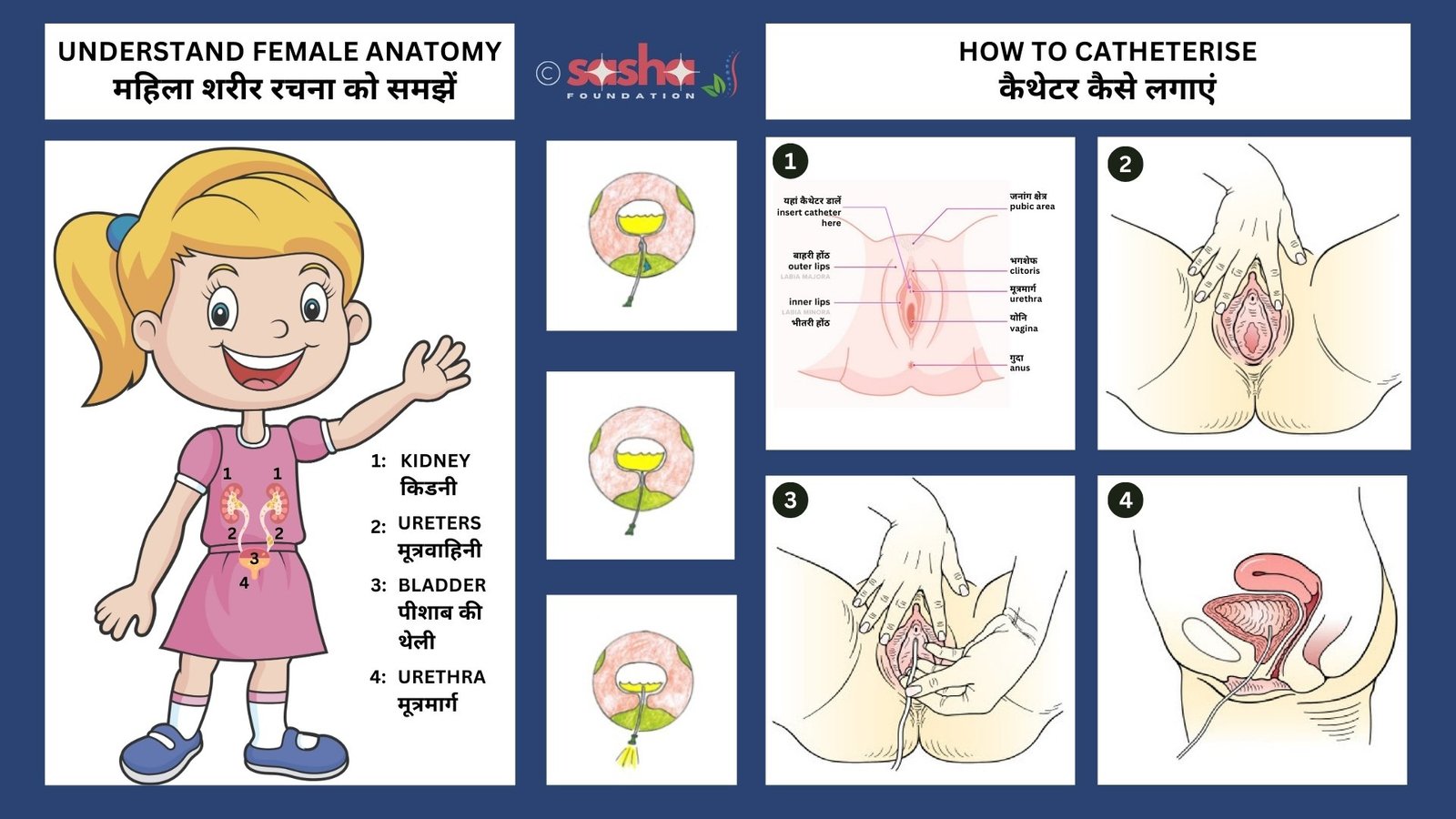
Step 1 – Have the child or adult lie comfortably on a bed and get them into a good position.
Step 2 – Put the reusable bed protector sheet under their buttocks
Step 3 – Take the underwear or the diaper off. Fold the top or the T-shirt upwards so it doesn’t come in the way.
Step 4 – Make sure the underwear or the diaper doesn’t have poop. If the diaper is soiled, follow the private part hygiene and hand hygiene process.
Step 5 – Wash your hands with soap and tap water.
Step 6 – Please follow the order and lay out the following necessary supplies at arm’s length so it is easy to reach.
- Washed/boiled SS Container to keep the catheter. We will keep the catheter after we wash our hands.
- SS Container with lid that already has the Lox Jelly. Open the lid, but don’t touch the jelly yet.
- Something to clean the private parts next to the child or adult.
- Sanitizer
- Absorbent material to manage any spills
- A collection bag or SS container for collecting urine.
Step 7 – Wash your hands with soap and tap water, following the hand hygiene process explained earlier. After washing, only touch the three things that need to be touched. Don’t touch the tap with your hands to close it. Take someone’s help to close the tap or leave it open. If possible, get a tap that can be closed and operated with the elbow or back of your hand.
Step 8 – Now, pick the catheter and place it on the SS container. Do not remove the packaging jacket of the catheter.
Step 9 – In this step, we will insert the jelly into the child’s or adult’s urethra.
- Touch their vulva with your left (other) hand.
- Using your thumb and index finger (forefinger) of your left (other) hand, spread the labia (vaginal lips) (refer to the above image, image no.2).
- Now, with your right (dominant) hand, pick the jelly tube.
- Insert the tip (white nozzle) of the jelly tube into the urethral opening (small hole above the vagina) (refer to the above image, image no.1).
- Squeeze with force and push a good quantity of jelly into the urethra so it travels and lubricates deep inside urethra.
- Put the jelly back in its SS container.
- Leave the labia (vaginal lips).
Step 10 – Using both hands, pick the catheter from the SS container. Remove the catheter from its jacket (cover). Hold it in your left (other) hand. Make sure it doesn’t touch anything.
Step 11 – Now, pick the jelly with your right hand and start lubricating the catheter you are holding in your left hand. Lubricate the catheter all the way.
Please note: Some people lubricate the catheter till the halfway mark first, and once inserted till that mark into the urethra, they lubricate the other half that is out.
Step 12 – In this step, we will insert the catheter into the child’s or adult’s urethra.
- Spread their labia (vaginal lips) with your left (other) hand. Though out the process these vaginal lips have to kept apart so you have a clear access to the urethral opening.
- With your right hand gently insert the catheter into the urethral opening (the same place you inserted the jelly). Female urethras are shorter so you will reach the bladder faster (refer to the above image, image no.3).
- The urine will start flowing out, here. Even after the urine starts flowing, gently keep pushing the catheter for one more inch (refer to the above image, image no.4).
- Wait for the urine to drain out. Depending on the size (diameter) of the catheter, it could take 2-4 mins.
- Don’t think that the bladder is empty when the urine stops flowing. Not yet.
- Now, with your right hand, start pulling the catheter out slowly. You will see that again some urine is coming out, stop pulling the catheter and let it drain. Once the urine stops, start pulling the catheter out slowly and see if some more urine flows out. If urine is coming out again, wait for it to drain. This is to ensure complete emptying of the bladder.
- Remove the catheter fully once there is no more urine flow and you are sure the bladder is empty.
- Leave the vaginal lips.
Step 13 – Put the used catheter back in its jacket (cover) and throw it in a dustbin.
Step 14 – Clean the excess jelly that has come out from the urethra or fell from the catheter on the genital area
- With left hand spread the labia (vaginal lips) and gently press the tip of the urethra to squeeze the extra jelly out. Clean this excess jelly with tissue, toilet paper or a cloth that you made to clean the private part.
- Clean and dry the vulva with the same tissue or cloth. Wipe the extra jelly that is there.
Step 15 – Make the child or adult wear the diaper or underwear.
Step 16 – Remove the bed protecter sheet and put it aside or for wash.
Step 17 – Wash your hands with soap and tap water
Step 18 – Close the lid of the SS container that stores the jelly and keep it aside. Also, keep the SS container you used to store the catheter aside for washing or boiling.
Note for Everyone Who Reuses Catheters
We often get this question: “Should I wash and reuse a urinary catheter?”. The answer to this is, “No, you should not. It will lead to a high number of UTIs. However, there are situations where patients cannot afford a new catheter each time it needs to be changed.
While cost concerns are understandable, our observations show that reusing catheters can be equally, if not more, expensive than using disposable ones. Reuse often results in increased UTIs, thus increasing expenses from frequent doctor visits, additional urine cultures, extended antibiotic treatments, and the added burden of unnecessary suffering.
Never reuse a single-use catheter, as doing so increases your risk of infection and injury. However, if you’re reusing a catheter, properly clean and store your catheters between uses.
Note for Everyone Who Uses Feeding Tube (FT) as Catheters
Also, we commonly see that across genders, from 11-year-old kids to 35-year-old adults, are using feeding tube for intermittent self-catheterization and their health care providers are not correcting them.
In some situations, particularly in neonates and young children, a feeding tube might be used as a temporary urinary catheter, for example, when a child is too young or just starting intermittent self-catheterization. In some situations, an adult might be taught to use a feeding tube if he or she is just starting or has issues with getting used to catheterzation. For both the children and adults, this is a temporary option, and gradually, they should be taught and encouraged to move on to using proper dedicated intermittent catheters.
Besides taking a long time to evacuate urine, using a feeding tube for a long time could lead to knotting. Knotting is when the tube spontaneously knots inside the bladder, which will require surgical removal.
I am Tight on Budget: I can’t Practice the Use and Throw Method
Although we strongly discourage this approach, there are situations where it may be the only viable option for managing bladder health. If reusable catheters are employed, they must be adequately cleaned following the following guidelines
- Store your catheter in Betadine: Fill a stainless-steel container with enough Betadine to completely submerge the catheter. Choose a container with a lid or cover it with a stainless-steel cover. Ensure the container is cleaned and boiled weekly to maintain proper hygiene.
- Use plain forceps: Use plain forceps to remove the catheter from the Betadine-filled container. Ensure the forceps are cleaned and boiled weekly to maintain proper hygiene.
- Wash catheter with water before and after use: Thoroughly rinse the catheter under running tap water both before and after use. Ensure that it remains clean and does not come into contact with anything. Please don’t use hot water as it can damage the catheter and lead to urethra injury.
- Wash your hand: Wash your hand properly before you touch the container or the forceps.
- Reuse catheter only for a week: Avoid reusing a catheter for longer than a week.
Often, Indian doctors recommend this practice to their patients. It’s important to note that such recommendations typically come from doctors in government hospitals, primarily because these hospitals often lack the funding to provide a full month’s supply of single-use catheters to each patient or because of the poor financial condition of the user.
Emotional and Psychological Aspects of Self-Catheterization
Learning self-catheterization can bring a unique set of emotional and psychological challenges, particularly for individuals with Spina Bifida. This process may evoke feelings of anxiety, embarrassment, or frustration, as it often involves adjusting to a new routine that is critical for maintaining independence and health. The emotional response to self-catheterization may differ from person to person; however, it is important to acknowledge these feelings and address them constructively.
One of the most effective coping strategies is to seek support from others who understand the process. This support can come from healthcare professionals, family members, or Sasha’s support groups, comprised of individuals with similar experiences. Engaging in open discussions about the challenges of self-catheterization can help overcome apprehension and foster a sense of community. At Sasha, we offer invaluable insights into practical strategies for overcoming obstacles.
Maintaining a positive outlook throughout the self-catheterization process is also essential. Relaxation techniques, such as mindfulness or deep-breathing exercises, can alleviate stress associated with the initial learning period.
Lastly, it is crucial to remember that self-catheterization is a skill that can be mastered over time. Celebrating small milestones can significantly impact one’s emotional well-being and self-esteem. In time, individuals may find themselves more comfortable with the process, leading to increased confidence and independence. Thus, embracing both the challenges and rewards of self-catheterization can contribute to a positive, empowering journey toward self-management and autonomy.
Sasha’s Suggestion: A Catheterization-Friendly Washroom
A “catheterization-friendly washroom” is a restroom designed with features that accommodate individuals who catheterise, ensuring they can manage their needs safely, hygienically, and with dignity. A catheterization-friendly washroom also helps in reducing UTIs.
Here’s a breakdown of what makes a washroom catheterization-friendly:
- Private bathroom.
- Appropriate toilet and sink height.
- Sink with soap and hot water.
- A tap that can be opened and shut by elbow or back of the hand.
- Shelf under the sink or a rack to store everyday catheter and jelly supply.
- Clean and hygienic environment.
- Additional space.
- Waste disposal facilities.
- Handrails (for people who need support)
Links to Some of the Necessary Items we Talked About
These sellers we are mentioning here have not sponsored this and are not affiliated in any way or form. Please feel free to buy what you please, our goal is to guide you in the right direction. Disclaimer: we haven’t tried these products so we don’t take responsibility for durability or fit.
- Reusable bed protector sheet: BeyBee waterproof quick dry sheet
- Container for urine: IS IndoSurgicals unisex polypropylene autoclavable urinal
- SS Tray with lid for catheter: IS IndoSurgicals stainless steel instrument tray with cover
- SS Container for lubricant jelly: Sumeet stainless steel rectangle lunch box
- Intermittent catheters in India: Polymed and Romsons. Both make for males and females
- Lubricating jelly: Lox 2% (Lidocaine) by Neon Laboratories
Please Note
The information provided on our website is not intended as medical advice for any individual. Since specific cases may differ from the general information presented, SASHA recommends consulting a qualified medical or other professional for personalized advice.
About the Author

Raul/DJ Vivek
Meet Vivek Bharadwaj, a remarkable individual who has defied the odds and soared to new heights despite living with Spina Bifida. As the founder of the Sasha Foundation, Vivek tirelessly advocates for others facing similar challenges. His unwavering commitment to support, awareness, and empowerment had made a lasting impact on the Spina Bifida community.
FAQ
What is clean intermittent self-catheterization used for?
Clean Intermittent Self-catheterization (ISC) will help you empty your bladder completely and regularly.
Is it painful to self-catheterize?
Yes, in the beginning, it may be a little uncomfortable or painful but in time, with practice, this fades out.
What are the side effects of intermittent self-catheterization?
The most frequent complication of IC is a catheter-associated urinary tract infection (UTI). Other complications can include urethral/scrotal events including bleeding, urethritis, stricture, the creation of a false passage, and epididymitis.
What can happen if I stop intermittent self-catheterization?
Urinary tract infections (UTIs). Bladder damage. Kidney damage that will bring you to a dialysis table.
What are the benefits of intermittent self-catheterization?
There are two main reasons for catheterizing yourself. One is to empty your bladder on a regular schedule and to keep yourself dry. Another reason is to keep your bladder from getting over-distended. This keeps your kidneys healthy and prevents infections.
What are the four things needed for intermittent self-catheterization?
You need a disposable catheter, Lidocaine Jelly 2%, soap and free-flowing tap water.
What is the difference between an indwelling catheter and an intermittent catheter?
Indwelling Catheter: Inserted either through the urethra or the abdominal wall into the bladder and left in place for a period of time.
Intermittent Catheter: Inserted through the urethra into the bladder to empty it, then removed, practised several times a day.
What is a Foley catheter?
A foley catheter remains in place continuously and is changed regularly, as required, mostly by healthcare providers. A foley catheter is connected to a urine bag where the urine collects.
What is the difference between the French (FR) size of a catheter and its length?
Intermittent catheters and Foley catheters have French sizes according to the diameter, it has nothing to do with the length.
What is the best position to self-catheterize?
This varies from case to case. Stand in front of or sit on a toilet. You can also insert your catheter in a private room using a container to collect your urine.
How much Lidocaine Jelly should I use?
You should use Lidocaine Jelly in good quantity. A very well-lubricated urethra and catheter lead to fewer complications.
What are hydrophilic catheters and do I need them?
Hydrophilic catheters are polymer-coated self-lubricating ready-to-use right out of the package catheters. You don’t necessarily need them, but it would be nice to have them. They eliminate the usage of jelly and are on the expensive side. No company in India is manufacturing these.
How many times a day should you self-catheterize?
Usually, a good time is to catheterise every 2 ½ hours to 3 ½ hours. This varies from person to person as it depends on their bladder capacity. This is also connected to how much fluid you are taking.
When to stop intermittent self-catheterization?
Never, in a Spina Bifida case. Otherwise, if the amount of residual urine stays below 50 ml, you may be able to stop doing intermittent catheterization.
Why is there blood when I self-catheterize?
Normally you don’t see blood in catheterization but if you do, either you have hurt yourself by not using proper lubrication or in some cases, severe urinary tract infection can cause this.
How much water should you drink if you self-catheterize?
You should drink a good amount of water even if you catheterise. However, before bed or if you are stepping out for pleasure, you can regulate the liquid intake.
I am scared of self-catheterization and the UTIs that come with it, what should I do?
Please get in touch with us at SASHA Foundation. We will help you reduce UTIs drastically.
What to do if you can’t self-catheterize?
You can get help from your parents or siblings. Guide or teach them how to catheterise and avoid UTIs.



Leave a Reply
You must be logged in to post a comment.