


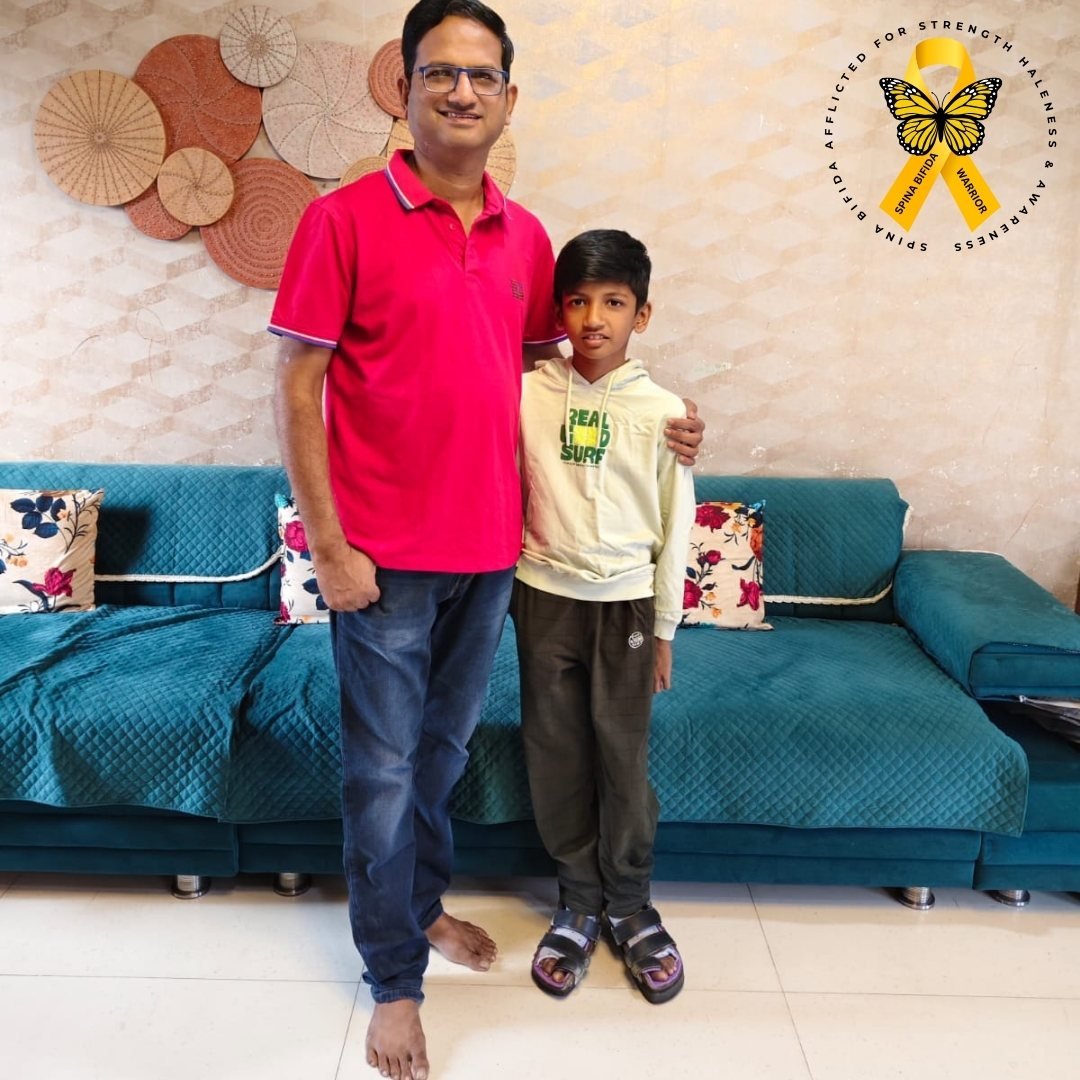
Meet Dr Rahul Salve, doctor, parent, husband, and father, whose son, Rushil, has Spina Bifida. Dr Rahul Salve has the unique privilege of being a doctor. Drawing on his firsthand experience of bringing up a son with Spina Bifida, Dr Rahul Salve wants to share what his son and his life have been like so others can better understand that experience. Dr Rahul Salve personally wrote his story, and the Q&A section was compiled by the article’s author.
Dr Rahul Salve and Rushil’s Story
I am Dr Rahul Salve, a Paediatrician, and my wife is an Anaesthetist. Both of us are practising medicine at Bhadrawati, Maharashtra. I have an 11-year-old son, Rushil, who was born with Spina Bifida (Myelomeningocele) and a left foot drop.
My wife and I were both shocked after his birth, as his antenatal scan showed a normal spine. The swelling on his lower back was covered with skin; hence, there was no hurry for the Myelomeningocele surgery. He was operated upon when he was 6 months old.
Right after the Myelomeningocele surgery, his bladder and bowel functions deteriorated, dribbling of urine started, and constipation developed. We started giving him homoeopathic medicines, but that was a waste of money and time. A USG abdomen at the age of 10 months suggested mild hydronephrosis (swelling over the kidneys), which led us to start clean intermittent catheterization (CIC). After starting CIC, my son’s kidney swelling resolved, and his kidneys became normal. We do the USG abdomen and serum creatinine test yearly. He also needs his bladder relaxant medicine daily. In school, he wears a diaper, and at home, he is free from diapers.
Initially, for bowel management, we used lactulose and polyethylene glycol (PEG), but we couldn’t empty his bowel adequately. My son can’t hold a glycerine suppository due to poor anal tone, so we decided to shift to manual removal of stool. Doctors advised MACE and Mitrofanoff procedures for bladder and bowel management, but we decided against these surgical procedures. We are managing his bladder and bowel conservatively, and it is working well for us.
My son uses an ankle-foot orthosis (AFO) to manage his foot drop. The AFO helps him a lot; with the AFO, he can play with other children with ease. My son’s left leg is shorter by 3 cm and is advised to undergo surgery by a paediatric orthopaedician.
This has been the journey so far. The future challenge that lies in front of us as parents is to make him independent in managing his bladder and bowel, which is to teach him CIC and manual removal of stool.
My son enjoys playing and chatting with his friends. He is also a good swimmer. He loves to draw and paint. He attends school regularly and is doing well in his studies.
Q & A with Dr Rahul Salve
Q – What is your full name and age?
A – My name is Dr Rahul Salve, and I am 42 years old.
Q – Dr Rahul Salve, which city do you live in?
A – I live in Bhadrawati, Maharashtra
Q – What is your profession?
A – I am a paediatrician and have been practising for 14 years.
Q – Dr Rahul Salve, does your wife work? If yes, what does she do?
A – Yes, my wife works. She is an Anaesthetist.
Q – Dr Rahul Salve, when did you both get married?
A – We got married in 2012.
Q – Dr Rahul Salve, how many kids do you have?
A – I have two sons. One is 11 years old, and the other one is 6 years old.
Q – Dr Rahul Salve, which son of yours has Spina Bifida?
A – My elder son, Rushil, has Spina Bifida.
Q – What type of Spina Bifida does your son have?
A – He has Myelomeningocele. His Myelomeningocele was covered with skin.
Q – Does he have Hydrocephalus, as well?
A – No, he doesn’t have Hydrocephalus.
Q – Dr Rahul Salve, does anyone in your immediate or extended family have Spina Bifida?
A – No, no one in our family has Spina Bifida.
Q – Dr Rahul Salve, when you were planning to become parents, did your wife take folic acid?
A – Yes, my wife took folic acid.
Q – It’s widely known that the majority of pregnancies around the world are unplanned, which often results in mothers beginning to take folic acid only after confirming their pregnancy. Typically, gynaecologists recommend folic acid during the initial post-pregnancy consultation. Since both of you are doctors, I am curious—did your wife start taking folic acid well before conception, or was it after she discovered she was pregnant?
A – My wife started taking folic acid three months before conceiving.
Q – Just for record’s sake, did your gynaecologist talk to you about folic acid supplementation?
A – Yes, our gynaecologists asked us if we have started taking folic acid supplementation or not.
Q – Dr Rahul Salve, how was your son’s Spina Bifida detected? Did the prenatal scan detect Spina Bifida?
A – My son’s Spina Bifida was detected post-birth. The prenatal scan did not detect his Spina Bifida. We got a 4D scan done, which showed a foot drop and a normal spine.
Q – Did the first trimester ultrasound scan show this foot drop, or did the second trimester one?
A – The second trimester (18-22 weeks) showed this foot drop.
Q – Dr Rahul Salve, so your son’s Spina Bifida was detected after his birth?
A – Yes, my son’s Spina Bifida was detected post-birth. I noticed a swelling on his back, and I knew what it was.
Q – Being doctors, you are well-acquainted with medical complexities, yet many parents lack awareness or understanding of conditions like Spina Bifida. When you discovered that your child was born with Spina Bifida, what were the thoughts and emotions that ran through your mind—as a doctor, as a husband, and as a man?
A – The first thoughts that came to mind were whether in future he will have bladder and bowel control or not, how soon we should get him operated upon, how he will manage his life, etc. I sought the paediatric surgeon’s opinion on his surgery.
Q – Do you remember the conversation you had with your wife after this diagnosis? How was she dealing with this discovery?
A – Yes, my wife and I spoke. She was feeling depressed, and so was I. We took all the precautions and did all the tests, but my son was born with this birth defect. We were both in a state of shock.
Q – I occasionally encounter questions about termination (abortion), particularly in cases involving conditions like Spina Bifida. In your situation, the diagnosis of your son’s Spina Bifida was not revealed during any ultrasound scans. However, some parents do learn about this condition in early screenings. Despite this, many decide against termination, often guided by their religious beliefs or personal convictions.
As both a doctor and a father, you have witnessed firsthand the challenges faced by individuals living with Spina Bifida. What are your views on the option of termination in such cases, and do you believe it is a choice people should consider if presented with the opportunity?
A – As both a doctor and a father, if Spina Bifida is detected in the antenatal scan, it mostly means that it is a significant Spina Bifida. Antenatal scans cannot reliably determine whether a child will have bladder or bowel control. In my opinion, it is better to terminate as it is going to be a significant Spina Bifida, and both parents and the baby will have to suffer.
Q – Dr Rahul Salve, when was your son operated on for Myelomeningocele surgery? Was he operated on the same day he was born, the next day or after some weeks or months?
A – He was operated upon when he was 6 months old. The swelling on his back was covered with skin, so there was no hurry for the surgery.
Q – Did you take this surgery call, or did your doctor give you this advice that we will operate when he is 6 months old?
A – I didn’t take this call. Our doctor suggested that we wait till he turns 6 months old. We knew that in 6 months, he would gain some weight. Also, in 6 months, he would be able to handle the anaesthesia better, as this is a major surgery.
Q – As we know, the location of Myelomeningocele plays a significant role in determining a child’s mobility. I have observed that nearly all children with Myelomeningocele, whose surgery has been delayed for any reason, seem to retain the ability to walk. For example, even my surgery took place late. My doctor told my parents that we would operate after I had walked. Naturally, this observation warrants further investigation, and I am in the process of gathering data. Do you have any insights on this, or is there anything you’d like to contribute?
A – Yes, I have noticed this. Especially in my child’s case, where the swelling was covered with skin, there was no hurry to operate. In my opinion, it is better to operate on the child after he or she starts walking. This delay also reduces neurological deterioration, such as weakness in the legs or bladder issues.
Q – Dr Rahul Salve, could you share your son’s location of Myelomeningocele?
A – L5
Q – Dr Rahul Salve, where did this Myelomeningocele surgery take place?
A – We got him operated on in Hyderabad.
Q – Dr Rahul Salve, you chose a private hospital or a government hospital?
A – We chose a private hospital.
Q – Dr Rahul Salve, is your child wheelchair bound? Does your child have any mobility issues?
A – No, my child is not wheelchair bound. He doesn’t have any mobility issues.
Q – What are the other surgeries that your son has gone through besides the Spina Bifida surgery?
A – He has had only one other surgery, for Phimosis. Phimosis is a circumcision surgery. We wanted to reduce the chances of infections.
Q – Dr Rahul Salve, how old was Rushil when you got his circumcision surgery done?
A – Rushil was 2 years old.
Q – In your story, you wrote that your son has orthopaedic issues. Could you please share what these issues are?
A – The power in his left foot has been missing since birth. Also, the growth of his left foot is comparatively less. There is a 3 cm difference in length between his left foot and his right foot. Our orthopaedic surgeon has advised surgery for this.
Q – Dr Rahul Salve, could you tell us about this surgery?
A – This would be a growth modulation surgery. They will halt the growth of the right foot with the help of screws. They will remove these screws once the length of both the legs is similar.
Q – How are you managing other orthopaedic issues? You mentioned in your story that your son uses an AFO (Ankle Foot Orthosis).
A – Yes, he is using an AFO in his left foot. He uses an AFO when he goes out.
Q – Dr Rahul Salve, Rushil doesn’t wear an AFO at home?
A – We advise Rushil, but he doesn’t wear them at home.
Q – Dr Rahul Salve, where did you get these AFOs made, and what was the approximate cost?
A – We get them made in Nagpur. The approximate cost is Rs.5,000.
Q – How did your son react when you shared that he would need to wear AFOs? Was he accepting and comfortable with the idea, or did he encounter challenges, such as teasing at school, while wearing them?
A – He did say that he wanted to wear regular shoes to school, but when we told him that he had to wear these special shoes, he accepted it. The regular shoes didn’t fit him well, and he understood that he needed to wear AFOs.
Q – Dr Rahul Salve, do you have the UDID card (disability certificate)?
A – Yes, we got his UDID card made.
Q – Could you share his disability percentage?
A – His disability percentage is 55%.
Q – Dr Rahul Salve, does he have a permanent disability or temporary disability certificate?
A – He has a temporary disability certificate, which is valid for 7 years. We have to get it reevaluated once this period is over. Earlier, his temporary disability certificate was valid for 5 years.
Q – Dr Rahul Salve, did you face any issues in making his UDID card?
A – No, we did not face any issues.
Q – Although doctors assessing disabilities are required to refer to or follow a gazette, there is a lack of uniformity in assessments across India. Cases of Spina Bifida with similar comorbidities often receive varying disability percentages depending on the state and the doctor conducting the evaluation. Even in identical cases, the percentages differ. What is your opinion on this inconsistency, and what steps do you think the government can take to address and improve this situation?
A – I feel wheelchair-bound individuals should get a better percentage; every orthopaedic issue should be considered. They don’t consider bladder and bowel incontinence as disability, which they should.
Q – What do you do for your child’s bladder management? Does your child practice intermittent catheterization (CIC)? If yes, at what age did you start CIC for your child?
A – We practice intermittent catheterization to empty his bladder. We started CIC when he was 1 year old. Surgeons had advised CIC right after his Myelomeningocele surgery, but we didn’t follow through. We were hesitant in the beginning. We did a USG abdomen, which suggested mild hydronephrosis, and right after this discovery, we started CIC. We started late, but we have been practising CIC regularly.
Q – Dr Rahul Salve, do you catheterise him, or have you divided the CIC schedule between your wife and you?
A – We have divided the CIC schedule between my wife and me.
Q – Dr Rahul Salve, how many times in a day do you catheterise your son?
A – We usually do 4-5 times a day. CIC varies seasonally; for example, in summer, we do around 4 times and in the rainy season, it is about 5 times. It also depends on his fluid intake.
Q – What do you use for CIC, a catheter or a feeding tube?
A – We use a feeding tube.
Q – Dr Rahul Salve, why are you not shifting to a catheter?
A – The feeding tube has a marking which helps.
Q – Dr Rahul Salve, could you tell us the size and brand of the feeding tube you use?
A – We use Romson’s FG 9 or FG 10. We follow the use-and-throw method. We don’t reuse feeding tubes.
Q – UTI is something that bothers everyone who catheterises. How many times a year does your son get UTIs? Could you share an approximate figure?
A – Earlier, he used to get UTIs around twice a year. Now, he gets once or twice in two years or so.
Q – Dr Rahul Salve, this is amazing. Staying UTI-free for such a long time is commendable. Could you share how you are managing this, as readers can learn a thing or two?
A – I believe there are a couple of reasons why Rushil experiences fewer UTIs. We always clean our hands thoroughly with soap and water or sterillium before each catheterization. Additionally, we apply Betadine 5% solution to the genital area before the procedure.
Q – One of the first signs of UTI is fever with chills. It has been observed that most people who get frequent or recurrent UTIs stop experiencing fever with chills. Does your child get a fever with chills, or what are the signs that your son experiences when he has a UTI?
A – Yes, he also doesn’t get a fever with chills when he has a UTI. His signs are smelly urine, a change in urine colour and frequent urination.
Q – In your story, Dr Rahul Salve, you mentioned that the USG scan suggested Hydronephrosis and you started regular, timely catheterization. There are lots of individuals who don’t catheterise despite knowing that this could lead to kidney complications and even failure in some cases. Some don’t want to catheterise because of pain or discomfort, and some because of fear of UTIs. What advice would you give to such individuals?
A – Catheterization is a must in neurogenic bladder cases. Catheterization relieves the bladder pressure, thus saving the kidney from damage. It also reduces frequent UTIs. Frequent UTIs can damage the kidneys.
Q – Many individuals wash and reuse catheters or feeding tubes. Everyone’s reason could be different. Some individuals are tight on a budget. Some individuals do so because their doctor has advised them to. In your opinion, is this the best practice? What are your thoughts on this?
A – Most intermittent catheters are intended for single use and should, therefore, be avoided for reuse.
Q – Dr Rahul Salve, does your son have SUI (Stress Urinary Incontinence)? If yes, how are you dealing with it? Is he on some medication for urine leakage? Does he use diapers?
A – He wears diapers at school and family functions. At home, he doesn’t use diapers. At school, we can’t catheterise him; that’s one of the reasons he wears diapers at school. Yes, we are giving him Mirabegron (25 MG) and Solifenacin (5 MG) in combination for managing OAB (Overactive Bladder)
Q – Dr Rahul Salve, what tips would you give people to stay UTI-free while catheterization?
A – To stay UTI-free, one should wash hands properly with soap and water. If you can’t wash your hands, use hand sanitiser. Maintain good hygiene.
Q – What do you do or follow for your child’s bowel management?
A – We do manual removal of stool.
Q – How frequently do you do manual removal of stool, or what schedule do you follow? Do you do it once a day or twice a day? Do you do this every day at a fixed time?
A – We perform manual bowel emptying using examination gloves once a day before he goes to school, right before his bath. If we feel that his bowel has not been completely emptied, we repeat the process once more after he returns from school. I believe that constipation is useful in cases of Spina Bifida as loose stool can lead to accidents. As there is no anal control, loose stool can pass while playing, etc., and one will have to wear diapers all the time.
Q – Your son goes to school; which class is he in?
A – Right now, he is in the 5th standard.
Q – A lot of parents face issues when they try to get school admission for their child with disability. Did you face any issues with your son’s admission to school?
A – No. I didn’t face any issues. My son’s school was very supportive. For example, boys needed to wear shorts in school, and when we explained our side, my son was allowed to wear trousers.
Q – Attending school as a Spina Bifida child could be challenging. Could you share your thoughts on this? If your son faced challenges, what were they, and how did you overcome these challenges?
A – We requested the school principal to assign him a ground-floor classroom, but unfortunately, they did not agree. As a result, he has to carry a heavy school bag to a first-floor classroom, which is challenging for him.
I feel it will also be challenging for us when my son’s school timing gets extended. As of now, his school is only for 5 hours. We have put him in a state school because of this. We do CIC once before the school and once right after he comes home. As and when the school time increases, it will become challenging, and we will have to figure out the catheterization part. He might have to do CIC all by himself. We will work on teaching my son how to catheterise.
Q – Has your son faced any bladder or bowel leakage (soiling his diapers or pants) during school hours?
A – There was one incident of bowel leakage at school. Rushil informed the teacher that he was not feeling well and had abdominal pain, but the school staff did not contact us. We have since informed his class teacher to please be attentive and to call us immediately if he reports feeling unwell again.
Q – Can your son exert pressure and pee or not?
A – Yes, with pressure, he can pee a little.
Q – Have you informed his teachers about him having Spina Bifida and requested their support?
A – Yes, we have informed his teachers that he has bladder and bowel issues. He won’t be using the washroom at lunchtime, and if there is any problem, please call us. We have informed his tuition teacher as well because he doesn’t like to wear diapers at tuition.
Q – At times, we hear these cases where schools refuse admission to children with disabilities. What are your thoughts on this, and how can we bring change? Make education accessible for all children with disabilities?
A – Schools should be forthcoming in admitting children with disabilities. They should have classes for such children on the ground floor rather than on higher floors. All schools should be designed keeping accessibility for wheelchair bound children in mind.
Q – In India, parents aspire for their children to excel academically, regardless of whether the child faces challenges or not. The desire for outstanding academic performance is deeply ingrained in Indian parents. As a doctor, you likely understand these expectations firsthand, having experienced them from your parents. Do you hold similar aspirations? If so, what kind of expectations do you have for your son, who has Spina Bifida?
A – Yes, we have expectations. We have told our son to decide on what he wants to do or pursue. We have told him to do what he likes. He is good in studies. I believe he will do well. Also, there is a 4% reservation for people with disabilities, so I think he will be fine.
Q – Do you or your wife pressure your son on grades?
A – He is good at studies but doesn’t pay good attention to them. He has a carefree attitude. We tell him to finish his homework on time, but we don’t put any pressure on him to come in the top three or anything like that.
Q – What advice would you give to parents who have children with Spina Bifida on how to keep their children motivated to make a better version of themselves? What approach should parents follow or focus on?
A – One is that they should put their children in a regular school rather than a school that teaches children with disabilities. This way, the child will easily blend in with other children. I don’t think we should pressurise children with Spina Bifida as they already have challenges that they are tackling in their daily lives.
Q – What do you think are the best streams in which children with Spina Bifida can excel or do well?
A – Any stream that allows a person to sit at any one place and manage daily things. For example, self-employed professionals like artists, musicians, doctors and chartered accountants.
Q – Many people who are fighting chronic issues like Spina Bifida try alternative medicine and alternative healing methods. People try Ayurveda, Homeopathy and Unani medicines. In your story, you also mentioned that you tried Homeopathy, but it didn’t help. Do you think these are good options, and should people try them?
A – These options are not at all helpful. It is a complete waste of time and money. Our Homeopath told us that there was no need for CIC, but I am glad that we didn’t listen to him and started CIC.
Q – What are your thoughts on Cystoplasty, Mitrofanoff and MACE surgeries? Often, these surgeries are presented as game changers by many doctors. Should people get these done? What are your thoughts on these surgeries versus conservative solutions that are available?
A – My son was also advised to get these surgeries, but we decided not to get them done. Why should you get these surgeries done when we can manage conservatively? You have to catheterise even if you get Cystoplasty and Mirofanoff both done. Also, these procedures are irreversible, so we decided to manage conservatively. If needed, we will wait for our son to grow up and let him take this call. We are managing well, conservatively.
Q – You already mentioned that you are happy managing bladder and bowel conservatively. These Cystoplasty, Mitrofanoff and MACE surgeries are suggested to everyone, including us. What suggestion or advice would you give to parents who are advised of these three procedures?
A – Parents should first try conservatively. They should think well before opting for these surgeries, as they are irreversible. Let your children grow and decide, as this procedure can be done at any point in life.
Q – Has your child ever asked you what he has and why this happened to him? Or why is he different from other children? If he has asked, what was your reply or if he hasn’t and asks in future, what would you tell him?
A – Yes, he asks why this has happened to me. We tell him that you have a birth defect. Often, he asks when I will get better. We tell him that research is going on, and we might have a solution. We give him examples of how earlier he used to wear diapers all the time, and now he doesn’t. New medicines keep coming, and slowly, this will get better.
Q – Another important topic that warrants discussion: the decision faced by parents whose first child is born with Spina Bifida. Some parents choose not to have another child out of fear or uncertainty. Others may feel financially constrained, unable to bear the cost of meeting the medical needs of their first child. Some are financially stable but worry about dividing their time, energy, and resources between their children.
As both a parent of a child with Spina Bifida and a medical professional, what are your thoughts on this matter? In your opinion, should parents in such situations consider having another child? Why or why not?
A – I feel that one should have another child if their first child has Spina Bifida. Having a second child divides attention in a good way. With a second child, you are busy taking care of two children instead of one, which leads to fewer negative thoughts, and your mind feels lighter. In future, the abled-bodied child can help in looking after the Spina Bifida child, financially, physically and emotionally. I believe that stress levels reduce after the second child.
Q – What advice would you give to expectant parents who just learned that their unborn child has Spina Bifida?
A – I would suggest termination if the antenatal scan suggests the unborn child has Spina Bifida.
Q – Do you have any demands for the government, or is there anything you want to start to bring change for people with disabilities? What do you think the government should do or change to help people with disabilities?
A – If you notice, our government plays a big role in polio immunisation. I believe that Spina Bifida is a bigger issue than polio today. Spina Bifida is a severe problem, and the government should work towards the prevention and management of Spina Bifida. I feel Spina Bifida people should get insurance coverage. The insurance companies in India refuse to cover people with Spina Bifida. The government should work towards preventing Spina Bifida and promoting folic acid consumption. The fortification of food should be done.
Q – I believe that the Indian government should include people with disabilities in Ayushman Bharat. Spina Bifida is a money-draining disability. What are your thoughts on this?
A – Yes, the government should include Spina Bifida individuals in Ayushman Bharat.
Q – At times, I see that parents blame themselves, thinking that it was their fault that the child has Spina Bifida. Frankly, it is no one’s fault. People who take folic acid might also face Spina Bifida. What would you say to such parents who blame themselves?
A – No parent would want their child to suffer. One should not blame oneself; this will only create difficulties.
Q – What are your thoughts on love and marriage for individuals with Spina Bifida or disabilities? Across the world, people with disabilities often face significant challenges when it comes to finding love. This topic is rarely seen as a priority by most parents, who often overlook the need for open discussions about it. In India, especially, many parents believe that people with disabilities cannot have a meaningful love life or marriage, and thus feel there is no need to address the subject. What do you think? Have you ever considered your son’s future in terms of love and marriage?
A – I believe it is best if one finds love. There should be honest dialogue between partners. Spina Bifida males, depending on the location of Myelomeningocele, could have sexual problems like erectile dysfunction, and it is best to let their partner know before marriage. I feel that a person with disability who is gainfully employed should not have problems in finding love.
Q – Can parents contact you for support and guidance? How can they contact you?
A – Yes, I am always available for support or assistance. Please feel free to contact me:
Dr Salve’s Mobile: 9673417480
Dr Salve’s Email: rsalve20@gmail.com
Please Note
The information provided on our website is not intended as medical advice for any individual. Since specific cases may differ from the general information presented, SASHA recommends consulting a qualified medical or other professional for personalized advice.
About the Author

Raul/DJ Vivek
Meet Vivek Bharadwaj, a remarkable individual who has defied the odds and soared to new heights despite living with Spina Bifida. As the founder of the Sasha Foundation, Vivek tirelessly advocates for others facing similar challenges. His unwavering commitment to support, awareness, and empowerment had made a lasting impact on the Spina Bifida community.



Leave a Reply
You must be logged in to post a comment.